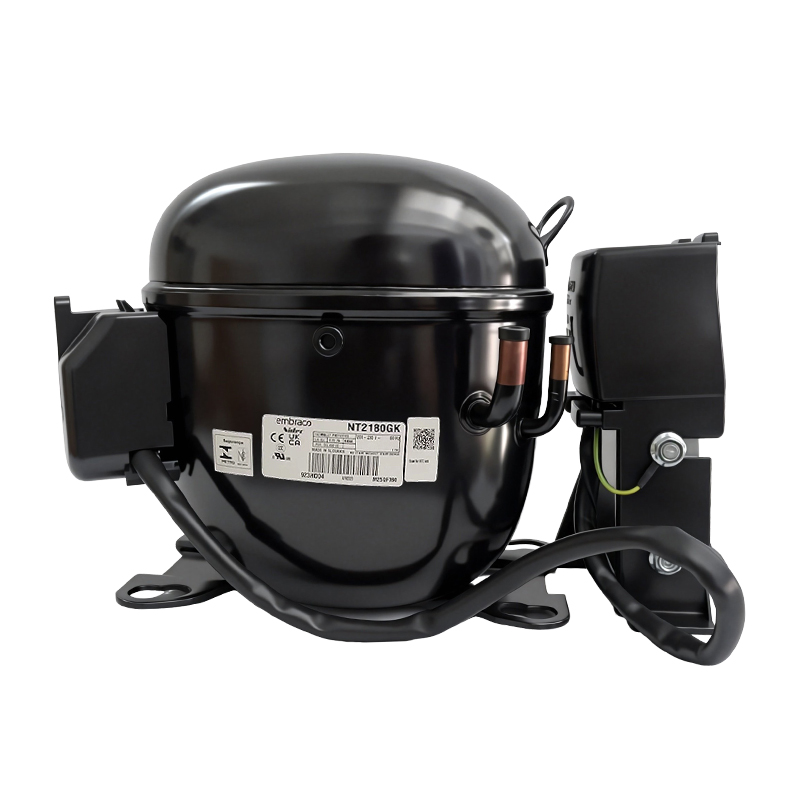
Embraco EMY3130Z Refrigeration Compressor

Embraco EMY3130Z Refrigeration Compressor: R134a LBP Technical Data and Selection Guide
The Embraco EMY3130Z is a single-phase, 220-240 V 50 Hz hermetic reciprocating compressor built for R134a duty. It displaces 11.14 cm3, runs a low-start-torque CSIR motor with a 16.04 A locked rotor current, and the manufacturer's catalogue gives 320 W at 1.50 W/W at the ASHRAE LBP check point of -23.3 C evaporating and 54.4 C condensing.
What Is the Embraco EMY3130Z?
The EMY3130Z is a fixed-speed hermetic reciprocating compressor in the Embraco EM family, sourced from China and sold into small commercial and appliance refrigeration on R134a at 220-240 V and 50 Hz. The manufacturer's catalogue carries it in the `220-240 V 50 Hz | R134a | LBP` block, prints its displacement as 11.14 cm3, its envelope as L/MBP and its starting torque class as LST, and documents it with a CSIR motor. Its only published refrigerant is R134a. Inside the supplier's Embraco Aspera compressor range it sits in the low and medium back pressure part of the ladder.
Two published capacity grids bracket the machine. At low evaporating temperatures, the catalogue prints 154 W at -35 C, 196 W at -30 C and 278 W at -25 C. Across the medium band it prints 387 W at -20 C, 513 W at -15 C, 644 W at -10 C and 771 W at -5 C. A separate check point block at -23.3 C evaporating and 54.4 C condensing gives 320 W at an efficiency of 1.50 W/W. Read in sequence those numbers are smooth and monotonic, and that single fact is what makes the rest of this page checkable rather than merely quoted.
One caveat governs the whole guide. The manufacturer's catalogue prints a model number nomenclature block that appears to encode capacity directly, and for this model that block, read literally, produces a figure roughly a hundred times larger than any capacity the same catalogue tabulates. The two cannot both be right. This page uses the tabulated values and records the nomenclature rule as an unresolved contradiction rather than papering over it. Everything below is drawn from manufacturer-issued documents, and the one place where the manufacturer's own catalogue disagrees with itself is named explicitly.
Key facts at a glance
| Item | Value | Basis |
|---|---|---|
| Model | EMY3130Z | Catalogue page 48, Model column |
| Compressor family | EM / EH, third generation | Catalogue page 8, nomenclature block |
| Compressor type | Hermetic reciprocating, fixed speed | Catalogue page 48, block header and row |
| Refrigerant | R134a | Catalogue page 48, block header; nomenclature code Z |
| Origin | CN (China) | Catalogue page 48, Origin column |
| Displacement | 11.14 cm3 | Catalogue page 48, Displacement column |
| Voltage and frequency | 220-240 V, 50 Hz, single phase | Catalogue page 48, Voltage column and block header |
| Envelope as printed on the model row | L/MBP | Catalogue page 48, Envelope column |
| Envelope as printed on the block header | LBP | Catalogue page 48, block header |
| Starting torque class | LST | Catalogue page 48, Torque column |
| Motor type | CSIR | Catalogue page 48, Motor column |
| Locked rotor current | 16.04 A | Catalogue page 48, LRA column |
| Published test condition | ASHRAELBP32 | Catalogue page 48, Test Condition column |
| Capacity at -35 / -30 / -25 C | 154 / 196 / 278 W | Catalogue page 48, Cooling Capacity block |
| Capacity at -20 / -15 / -10 / -5 C | 387 / 513 / 644 / 771 W | Catalogue page 49, Cooling Capacity block |
| Check point capacity | 320 W | Catalogue page 49, Check Point block at -23.3 C evaporating and 54.4 C condensing |
| Check point efficiency | 1.50 W/W | Catalogue page 49, Efficiency column |
| Oil charge | 210 mL | Catalogue page 49, Lubricant block |
| Lubricant type and viscosity | ESTER / ISO22 | Catalogue page 49, Lubricant block |
| Expansion device | Capillary tube | Catalogue page 49, Expansion Device column |
| Wiring diagram | SM07 | Catalogue page 49, Wiring Diagram column |
How the EMY3130Z model number decodes
The manufacturer prints a nomenclature block on page 8 of the same catalogue, using `EMY 3130Z` as its worked example. Quoted verbatim, the block reads:
COMPRESSOR FAMILY EM/EH
>
PRODUCT GENERATION - 1a Generation T - 2a Generation Y - 3a Generation X - 4a Generation C - 5a Generation D - Next Generation
>
EFFICIENCY LEVEL T - Standard E - Extended
>
APPLICATION CODE 1. LBP - LST 2. LBP - HST 3. L-MBP - LST 4. L-MBP - HST 5. M-HBP - LST 6. M-HBP - HST 9. M-HBP - HST
>
CAPACITY The first digit is the number of zeros that you must attach to the last two digits to obtain the capacity (aprox.) in kcal/h in 50 Hz. Ex.: 144 = 440 kcal/h em 50 Hz.
>
REFRIGERANT CODE U - R290 Z - R134a E - R22/R422D GK - R404A Y - R600a
Read against that block, the designation does three things, and only three.
| Field | What the block says | What this model carries | Cross-check |
|---|---|---|---|
| Family | EM / EH | EM | Page 48 groups this model under a block headed by the EM family generation |
| Generation | The character after the family is the generation marker; Y is the third generation | Y | The block's own worked example is `EMY 3130Z`, so the position is fixed by the manufacturer |
| Refrigerant | U is R290, Z is R134a, E is R22/R422D, GK is R404A, Y is R600a | Z, therefore R134a | Page 48 heads the block 220-240 V 50 Hz with R134a |
| Application and torque | Code 3 is L-MBP with LST | Envelope L/MBP with LST matches code 3 | Page 48 prints L/MBP and LST on this model's row |
The fourth field is where the designation and the table agree without being asked to. Code 3 in the printed application list is L-MBP with LST, and page 48 independently prints L/MBP and LST on the EMY3130Z row. The refrigerant letter agrees too: Z is R134a, and the block that contains the row is headed R134a. A sibling on the catalogue's R290 pages, EMY3134U, carries the same EMY generation marker with refrigerant letter U, which is the third independent confirmation that the trailing letter is the refrigerant code and not part of a capacity figure.
Two elements of the block are deliberately not decoded here. The first is the capacity field, handled in the next section. The second is the efficiency level: the block states that T means standard efficiency and E means extended efficiency, but it does not print the position of that letter inside a designation, so no efficiency letter is claimed for this model. The catalogue's own tables also list strings such as EMT55HLC, EMYS60HEP and EMU70HLC whose extra characters the block does not explain, and no decoding is offered for those.
Why the capacity digits in the model number are not used
The printed capacity rule is explicit. Take the last two digits, attach as many zeros as the first digit tells you to, and read the result as an approximate capacity in kcal/h at 50 Hz, with 144 given as 440 kcal/h. Applied to `3130`, the last two digits are 30 and the first digit is 3, so the rule yields 30,000 kcal/h, which is about 34.9 kW.
The same catalogue tabulates 320 W for this model at the check point. A factor of roughly 109 separates the two. The rule cannot be reconciled with the table by any reading of units, and the discrepancy is not a one off: applying the same rule to NE2130Z yields 3,000 kcal/h against a tabulated 314 W at -25 C, and to NEK2140Z it yields 4,000 kcal/h against 447 W. The offset is a consistent order of magnitude across the low back pressure R134a rows.
The practical conclusion for a buyer is narrow and firm. No capacity figure in this guide, or in any quotation built from this guide, may be derived from the digits in the model number. The tabulated watt figures govern, and where a supplier quotes a capacity without stating which grid it came from, the ASHRAE check point and the evaporating temperature must both be asked for. The contradiction is carried as an open item in the verification record rather than resolved, because resolving it would require a manufacturer statement that has not been found.
What documents this page is built on
The primary source is the manufacturer's own ASPERA catalogue PDF, served from the manufacturer's domain and covering the fixed-speed reciprocating range across all of its refrigerant families. It carries the R134a low back pressure block on page 48, the matching performance block on page 49, and the nomenclature block on page 8. Because that document is manufacturer-hosted, the primary evidence here needs no hosting caveat, unlike the situation where a model is documented only by distributor copies.
The catalogue's page 48 block is a 20 model table. It is legible, and its columns were recovered and then cross-checked against the page 49 performance block before any number was taken from it. The first rendering attempt mis-assigned displacement values by one row, which is why the cross-check exists: a displacement column that runs monotonically from 3.77 to 16.80 cm3 is internally consistent, and a capacity sequence that rises smoothly from 278 W at -30 C through 320 W at -23.3 C to 387 W at -20 C is consistent with it. Both tests are recorded in the verification file so that any later reader can repeat them.
What Are the Technical Specifications of the EMY3130Z?
Every value in this section is transcribed from the manufacturer's catalogue, from the page 48 block that carries the model row or from the page 49 block that carries its performance. Where the two disagree, both readings are shown and neither is chosen for the reader.
Compressor and refrigerant data
| Field | Published value | Source page |
|---|---|---|
| Model | EMY3130Z | 48 |
| Block header | 220-240 V 50 Hz, R134a, LBP | 48 |
| Origin | CN | 48 |
| Displacement | 11.14 cm3 | 48 |
| Envelope | L/MBP | 48 |
| Starting torque class | LST | 48 |
| Motor type | CSIR | 48 |
| Refrigerant | R134a | 48 |
| Expansion device | Capillary tube | 49 |
Electrical data
| Field | Published value | Source page |
|---|---|---|
| Nominal voltage | 220-240 V | 48 |
| Frequency | 50 Hz | 48 |
| Phase | Single phase, 1 phase | 48 |
| Motor type | CSIR | 48 |
| Starting torque class | LST | 48 |
| Locked rotor current | 16.04 A | 48 |
| Test condition | ASHRAELBP32 | 48 |
| Wiring diagram | SM07 | 49 |
The catalogue prints the same 220-240 V 50 Hz line for all 20 models in the block, which is what a block header is for. It does not print a separate running current, a nominal power input, or a capacitor value for this model, so none of those is quoted anywhere in this guide. A buyer who needs a capacitor sizing figure must obtain a model-specific data sheet from the supplier; the catalogue is not a substitute for it.
Lubricant and mechanical data
| Field | Published value | Source page |
|---|---|---|
| Displacement | 11.14 cm3 | 48 |
| Oil charge | 210 mL | 49 |
| Lubricant type | ESTER | 49 |
| Lubricant viscosity | ISO22 | 49 |
| Expansion device | Capillary tube | 49 |
| Wiring diagram | SM07 | 49 |
The lubricant is a POE ester at ISO 22 viscosity. That matters operationally: ester oils are hygroscopic, so an R134a circuit built around this compressor needs a properly evacuated, dry-charged assembly and short exposure times during service. The 210 mL charge is the catalogue figure for the compressor itself and does not include system piping.
The catalogue does not print a bore, a stroke, a weight, a height, or a tube diameter for this model in the blocks that were read. Rather than import those from a sibling, they are listed as not published. A sibling's bore is not this model's bore, and presenting one as the other is the single easiest error to make with a family catalogue.
Cooling capacity in the low evaporating band
The page 48 block prints four temperature columns, -40, -35, -30 and -25 C. This model's row carries values in the three warmest of them and leaves the -40 C cell empty.
| Evaporating temperature | Capacity | Basis |
|---|---|---|
| -40 C | Not printed | Catalogue page 48, cell empty for this model |
| -35 C | 154 W | Catalogue page 48, capacity grid |
| -30 C | 196 W | Catalogue page 48, capacity grid |
| -25 C | 278 W | Catalogue page 48, capacity grid |
Two things about this table need stating, because both are easy to get wrong when a family catalogue is read quickly.
The first is that the empty cell is at the cold end, not the warm end. In this block the values fill from the right, so a model with one published capacity has exactly one number and it sits in the -25 C column; a model with two sits in -30 C and -25 C; and a model with three sits in -35, -30 and -25 C. That convention was confirmed rather than assumed: for the sibling FFU160HAX, whose page 48 row carries 266 W and 355 W, reading the pair as -30 C and -25 C implies a 103 W step into the -20 C value of 458 W, which matches the 123 W per 5 K slope printed on page 49. Reading the same pair as -35 C and -30 C would put a 103 W change across a 10 K gap against a 123 W change across the next 5 K gap, which no compressor curve does. The same test applied to NE2130Z, NE2134Z and NEK2140Z returns the same answer, and it is the reason this guide places the EMY3130Z values at -35, -30 and -25 C rather than at -40, -35 and -30 C.
The second is that the missing -40 C cell is not an omission by a distributor or a rendering artefact. The block carries a footnote for missing data, and this row is simply not filled at -40 C. Nothing is inferred for that column, and no -40 C capacity is quoted anywhere in this guide.
Cooling capacity across the medium band
Page 49 continues the same R134a LBP sequence with the warmer columns, printed as a separate block with its own check point panel.
| Evaporating temperature | Capacity | Basis |
|---|---|---|
| -20 C | 387 W | Catalogue page 49, cooling capacity grid |
| -15 C | 513 W | Catalogue page 49, cooling capacity grid |
| -10 C | 644 W | Catalogue page 49, cooling capacity grid |
| -5 C | 771 W | Catalogue page 49, cooling capacity grid |
The ASHRAE LBP check point
Page 49 also carries a check point panel, headed as evaporating -23.3 C and condensing 54.4 C. For this model it prints:
| Check point field | Value |
|---|---|
| Evaporating temperature | -23.3 C |
| Condensing temperature | 54.4 C |
| Capacity | 320 W |
| Efficiency | 1.50 W/W |
| Oil charge | 210 mL |
| Lubricant type and viscosity | ESTER / ISO22 |
| Expansion device | Capillary tube |
| Wiring diagram | SM07 |
The check point is the number to quote when a single figure is wanted, because it is the only capacity in the catalogue that comes with a condensing temperature attached. The two grids are useful for curve shape; the check point is useful for comparison. Quoting 771 W without stating that it belongs to -5 C evaporating and an unstated condensing condition would be technically true and commercially misleading.
How the two capacity grids fit together
The published capacity readings can be placed on a single axis and read as one curve. Working from the cold end upward, the local gradient in watts per kelvin is as follows.
| Interval | Change | Gradient |
|---|---|---|
| -35 C to -30 C | 154 W to 196 W | 8.4 W per K |
| -30 C to -25 C | 196 W to 278 W | 16.4 W per K |
| -25 C to -23.3 C | 278 W to 320 W | about 25 W per K |
| -23.3 C to -20 C | 320 W to 387 W | 20.3 W per K |
| -20 C to -15 C | 387 W to 513 W | 25.2 W per K |
| -15 C to -10 C | 513 W to 644 W | 26.2 W per K |
| -10 C to -5 C | 644 W to 771 W | 25.4 W per K |
Each gradient is derived here from the printed watt values and is labelled as derived. Read as a sequence the curve steepens sharply in the cold band, from 8.4 W per K to roughly 25 W per K, and then holds almost flat across the whole medium band. That is the shape a fixed-speed reciprocating compressor is expected to produce, and it is internally coherent across two separate catalogue pages.
One caveat belongs with that table. The check point prints its condensing temperature as 54.4 C; the two cooling capacity grids do not print a condensing temperature at all, only the evaporating temperatures in their headers. The check point value therefore fits the sequence, but it is not proven to have been measured at the same condensing condition as the grid. The agreement in gradient is strong evidence that both blocks describe the same machine, and it is the reason this guide treats the page 48 capacity column as being in watts. It is not proof that a quotation built from the check point is interchangeable with one built from the grids, and a buyer comparing the two should ask which condensing condition applies.
How Does the Embraco EMY3130Z Perform?
Performance for a hermetic reciprocating compressor means four separate things, and the catalogue answers them to different depths. It answers the capacity question thoroughly, the efficiency question at a single point, the electrical question partially, and the acoustic question not at all. Separating those four is what keeps a specification sheet honest.
What the capacity curve shows
Across the seven published evaporating temperatures the capacity roughly quintuples, from 154 W at -35 C to 771 W at -5 C. The machine is therefore not a fixed-output device chosen once: it is a curve, and any system design that quotes a single number is quoting a point on it.
| Evaporating temperature | Capacity | Relative to the -35 C value |
|---|---|---|
| -35 C | 154 W | 1.00 |
| -30 C | 196 W | 1.27 |
| -25 C | 278 W | 1.81 |
| -23.3 C | 320 W | 2.08 |
| -20 C | 387 W | 2.51 |
| -15 C | 513 W | 3.33 |
| -10 C | 644 W | 4.18 |
| -5 C | 771 W | 5.01 |
The ratios in the last column are derived here rather than printed by the manufacturer, and they are labelled as derived for that reason. They are useful for one purpose only: showing that capacity gains accelerate as the evaporating temperature warms up. Between -35 C and -30 C the machine adds 27 percent; between -10 C and -5 C it adds 20 percent of a much larger base. A designer choosing this compressor for a low-temperature cabinet and a designer choosing it for a medium-temperature cabinet are sizing against materially different slopes.
What the efficiency figure does and does not say
The only published efficiency is 1.50 W/W at the -23.3 C check point. There is no efficiency column on the low band grid, and none on the medium band grid.
| Efficiency reading | Value | Basis |
|---|---|---|
| Check point efficiency | 1.50 W/W | Catalogue page 49, Efficiency column |
| Efficiency at -40 C | Not published | No efficiency column on the page 48 grid |
| Efficiency at -5 C | Not published | No efficiency column on the page 49 grid |
A coefficient of performance of 1.50 at -23.3 C evaporating and 54.4 C condensing is a normal figure for a small R134a low back pressure machine, and it is the number to use when comparing this model with a sibling. It must not be carried across to other evaporating temperatures. Extrapolating an efficiency upward because capacity rises is the classic error with this class of table, and the catalogue gives no basis for it. A buyer who needs the coefficient of performance at -10 C or at -30 C must ask the supplier for a model-specific performance sheet, because the family catalogue does not print one.
Motor and starting characteristics
The catalogue declares three electrical facts about this model: the motor is CSIR, the starting torque class is LST, and the locked rotor current is 16.04 A.
CSIR stands for capacitor start, induction run. It is a single-phase arrangement in which a start capacitor assists the machine up to speed and is then removed from the circuit, with the run winding carrying the machine thereafter. It is a heavier-duty arrangement than a plain resistance split, and it is the reason a start capacitor and a relay appear among the usual spares for a machine of this class.
The LST declaration is the one to read carefully. LST means low starting torque, and it is a statement about the pressure balance the compressor expects across its ports at the moment of start. The catalogue couples LST with L/MBP in its own application code list, where code 3 is L-MBP with LST. A low-starting-torque machine is built around the assumption that the system pressure equalises during the off cycle, which is why a capillary tube is printed as the expansion device. Where a system holds a pressure differential at restart, a low-starting-torque compressor is the wrong selection regardless of its capacity, and this is the single most common specification error on R134a appliance work.
The locked rotor current of 16.04 A is the figure that sizes the protection and the wiring. It is also, on this row, the single most useful cross-check available: an LRA in the mid teens with a capacity in the hundreds of watts is internally plausible, whereas an LRA in the low single digits against the same capacity would not be. The value is presented here only in amperes as published. No locked rotor current in watts, and no running current, is derived from it.
The envelope field disagrees with its own block header
The page 48 block containing this model is headed `220-240 V 50 Hz` with `R134a` and `LBP`. The model's own row prints its envelope as `L/MBP`. Those two statements are about the same compressor, on the same page, in the same table.
They are not equivalent. LBP means low back pressure only. L/MBP means low and medium back pressure, a wider envelope that reaches warmer evaporating temperatures. The block header is a section label applied to 20 rows at once; the row field is model-specific. Where a section label and a model field disagree, the model field is the more specific statement, but it is also the one a distributor is least likely to have copied correctly.
| Statement | Where it appears | Scope |
|---|---|---|
| LBP | Page 48 block header | Applies to all 20 models in the block |
| L/MBP | Page 48, EMY3130Z row | Applies to this model |
The practical effect of the disagreement is small for a low-temperature job and large for a borderline one. A cabinet design sitting near -10 C evaporating is comfortably inside L/MBP and right at the edge of LBP. The guide therefore reports both, and any quotation built from it should state the envelope and the evaporating temperature together. The page 49 block, which covers this model at -20 C to -5 C, is itself evidence that the envelope is not confined to the coldest band; a strictly LBP-only machine would not be tabulated at -5 C evaporating.
What is not published
Three performance figures that appear on many competitor sheets are absent from the blocks that document this model.
| Figure | Status in the manufacturer's blocks read here |
|---|---|
| Sound pressure or sound power level | Not printed for this model |
| Vibration limit | Not printed |
| Nominal power input in watts | Not printed |
| Running current | Not printed |
| Coefficient of performance away from the check point | Not printed |
None of these is estimated anywhere in this guide. Where a distributor sheet or a marketplace listing volunteers one of them for this model, it is a claim from a document the manufacturer did not issue in this form, and it should be verified against a model-specific data sheet before it is used in a design. Sibling models in the same family, such as EMT55HLR and EMS6170Z, carry their own sheets, and a figure that appears on one of them does not transfer to the EMY3130Z.
What Applications Suit the Embraco EMY3130Z?
The manufacturer describes the series before it describes the model, and the series description is the more reliable starting point because it is written for a whole product line rather than assembled from a table. On its own EM Series page the manufacturer states that the series is its best selling fixed-speed compressor series and that it "is suited for residential refrigeration appliances and small commercial applications", compact, with low noise and vibration, and that the series generations are EM2, EM3 and the later EMC. The same page lists the series' refrigerants as R134a, R290, R404A, R448A, R449A, R452A, R513A, R600a and R1234yf, its applications as LBP, MBP and HBP, its nominal capacity band as 3 to 12 cc, and its voltages as 100 V, 115 V and 220 V at 50 or 60 Hz. The series itself is one branch of the manufacturer's fixed-speed reciprocating compressor range, and a buyer who wants the manufacturer's own selection layer rather than a catalogue page can start from the manufacturer product selector.
Those series-level statements place the EMY3130Z precisely. At 11.14 cm3 the model sits at the top of the published 3 to 12 cc band, which is to say it is one of the largest displacements in the family rather than a mid-range machine. Its declared voltage is inside the published 220 V class, its refrigerant is one of the nine the series supports, and its envelope sits inside the published LBP, MBP and HBP span.
The envelope is the first screen, not the capacity
Selection on this class of compressor fails more often on envelope than on capacity. The catalogue prints the model's envelope as L/MBP, which reaches low back pressure and medium back pressure but stops short of high back pressure. The block header above the same row says LBP only.
| Envelope reading | Evaporating band it covers | Where it comes from |
|---|---|---|
| LBP | The coldest band | Page 48 block header, applied to 20 rows |
| L/MBP | Low and medium back pressure | Page 48, EMY3130Z row |
| LBP, MBP, HBP | The series span | Manufacturer EM Series page |
For a cabinet running near -30 C the two readings give the same answer and the disagreement is harmless. For a cabinet running near -10 C or warmer the difference decides whether the compressor is inside its declared envelope at all. A buyer quoting this model for a warmer duty should have the supplier confirm the envelope in writing, because the guide cannot settle a disagreement inside the manufacturer's own table, and the page 49 block that tabulates this model down to -5 C evaporating suggests the row field is right.
Equipment classes this displacement and capacity suit
The following mapping is derived here from the published displacement, the published capacity curve and the manufacturer's series statement, and is presented as reasoning rather than as a manufacturer application table. The manufacturer publishes application tables at family level; the blocks read here do not carry a per-model application list, so no cabinet volume, no product temperature and no duty figure is quoted for this model.
| Equipment class this suits | Why, from the published data |
|---|---|
| Small display and storage cabinets in the medium band | 387 to 644 W available between -20 C and -10 C evaporating, inside the declared L/MBP envelope |
| Drinking water coolers and similar small water equipment | The manufacturer lists drinking water equipment as one of its application categories, and the capacity band matches an appliance-scale load |
| Bottle coolers and beverage cabinets | 644 to 771 W at -10 C to -5 C suits a reach-in cabinet held just above freezing |
| Ice makers and small frozen food equipment in the low band | 154 to 278 W between -40 C and -30 C, the coldest published points |
| Appliance-scale condensing duties on R134a | Fixed speed, single phase 220-240 V 50 Hz, capillary tube, LST |
| Replacement of an existing R134a machine of the same displacement | Displacement and refrigerant are the two fields that must match on a replacement |
The pattern behind the table is worth stating plainly. This is an appliance-scale compressor. Its published capacity at the check point is 320 W, which is smaller than a single domestic light bulb circuit, and its displacement band sits at the top of a family the manufacturer positions for residential refrigeration and small commercial work. It is not a commercial refrigeration workhorse and should not be specified as one, however convenient its voltage and refrigerant may be.
Where the EMY3130Z is not the right choice
Four situations disqualify the model before capacity is considered at all.
- A system that does not equalise pressure during the off cycle. The declared starting torque class is LST, which is low. A low-starting-torque compressor expects a balanced pressure across its ports at restart. Where a system holds a differential, a higher starting torque class is required regardless of the capacity the catalogue prints.
- Duty above medium back pressure. The row envelope is L/MBP. A high back pressure or air conditioning duty falls outside it, and the series page confirms that HBP exists elsewhere in the family.
- A capacity requirement in the kilowatt range. The published range tops out at 771 W at -5 C evaporating. Requirements above the family band belong to a larger compressor, not to a larger evaporating temperature.
- A three-phase supply without a phase converter. The published line is single phase 220-240 V 50 Hz. The catalogue's R134a LBP block prints no three-phase variant of this model, and no variant at 60 Hz.
Where one of those applies, the practical next step is to move up the family rather than to read the capacity table more optimistically. Comparable machines in the supplier's range include NE2130Z one step up in displacement, NE2134Z and NEK2140Z for progressively larger low back pressure duties on the same refrigerant, and FFU160HAX and EGU130HLR where the application sits at the larger end of the family.
Matching the model to a duty in practice
Because no per-model application table is published in the blocks read here, matching is a four-step exercise using only published figures.
| Step | Question | Figure to use |
|---|---|---|
| 1 | What evaporating temperature does the duty need? | Pick the point on the -40 C to -5 C curve |
| 2 | What capacity does the load require at that point? | Read the corresponding watt value |
| 3 | Does the condensing condition match the check point? | If close to 54.4 C, quote the 320 W check point figure directly |
| 4 | Does the system equalise pressure on the off cycle? | If not, LST disqualifies the model |
Steps one and two are arithmetic on published numbers. Step three is the one that decides whether a quotation is comparable, because 320 W at -23.3 C and 387 W at -20 C describe the same machine under two different conditions. Step four is a system question and not a compressor question, and it is the one that most often sends a correctly sized machine back.
How Does the EMY3130Z Compare With Sibling Embraco Compressors?
The cleanest comparison available is against the other 19 models that share the EMY3130Z's own catalogue block. They are printed on the same page, in the same voltage and frequency class, on the same refrigerant, and with the same test condition for all but one of them. That makes the block a like for like ladder rather than a selection of loosely related machines.
| Model | Origin | Displacement cm3 | Envelope | Torque | Motor | Capacity at -25 C |
|---|---|---|---|---|---|---|
| EM45HHR | BR | 3.77 | L/M/HBP | LST | RSIR/CSIR | 113 W |
| EMI55HER | BR | 4.60 | LBP | LST | RSIR/CSIR | 113 W |
| EMT55HLC | CN | 5.19 | LBP | LST | RSCR | 138 W |
| EMYS60HEP | BR | 5.19 | LBP | LST | RSIR/RSCR | 134 W |
| EM65HNR | BR | 5.54 | L/MBP | LST | RSIR/CSIR | 138 W |
| EMU70HLC | BR | 5.96 | LBP | LST | RSCR | 145 W |
| NEK2116Z | SK | 7.37 | LBP | HST | CSIR | 127 W |
| FF8,5HBK | BR | 7.95 | L/M/HBP | LST | RSIR/CSIR | 168 W |
| FF8,5HBK | BR | 7.95 | L/M/HBP | LST | RSIR/CSIR | 198 W |
| EMY75HLC | CN | 8.35 | LBP | LST | RSCR | 193 W |
| NEK1118Z | SK | 8.39 | LBP | LST | RSIR/RSCR | 205 W |
| NE2121Z | SK | 9.26 | LBP | HST | CSIR | 227 W |
| EGU110HLC | BR | 9.50 | LBP | LST | RSCR | 249 W |
| EGU130HLR | BR | 10.61 | LBP | LST | CSIR | 288 W |
| FFU130HAX | BR | 10.61 | L/MBP | LST/HST | CSIR | 278 W |
| EMY3130Z | CN | 11.14 | L/MBP | LST | CSIR | 278 W |
| NE2130Z | SK | 12.11 | LBP | HST | CSIR | 314 W |
| FFU160HAX | BR | 12.92 | L/MBP | LST/HST | CSIR | 355 W |
| NE2134Z | SK | 14.28 | LBP | HST | CSIR | 329 W |
| NEK2140Z | SK | 16.80 | LBP | HST | CSIR | 447 W |
Every value in that table belongs to the model named on its own row. Sibling rows are not data for the EMY3130Z, and a reader comparing figures should treat each row as a separate machine. The comparison is useful for positioning and for finding alternatives, not for inferring what one model will do from what another does.
Three things in the table are worth calling out because they are visible only at family level.
The first is position. Ordered by displacement, the EMY3130Z sits sixteenth of twenty, between FFU130HAX at 10.61 cm3 and NE2130Z at 12.11 cm3. Two models share its displacement class without matching its capacity: FFU130HAX also displaces 10.61 cm3, and the EMY3130Z at 11.14 cm3 is the next step. At -25 C evaporating the two are then level at 278 W each, which is a reminder that displacement alone does not rank capacity across different motor and torque build combinations.
The second is the test condition exception. Nineteen of the twenty rows carry ASHRAELBP32 as their published test condition. NEK2116Z carries ARI540. Its 127 W at -25 C is therefore not directly comparable with the EMY3130Z's 278 W, and the two figures should never be placed in the same column of a comparison without that note. A buyer who needs a genuine like for like comparison with NEK2116Z must obtain the capacity under the same test condition.
The third is a duplication. FF8,5HBK appears twice, at the same 7.95 cm3 displacement, the same envelope, the same torque class and the same motor type, yet with two different capacity sets: 168 W against 198 W at -25 C. The catalogue does not explain the difference in the rows read here. Two builds distinguished only by an order code are common in family catalogues, but because the printed table does not say which is which, this guide reports both and asserts neither.
Where the EMY3130Z sits against its nearest alternatives
For a buyer choosing between this model and its closest neighbours, three comparisons matter most.
| Question | Answer from the published data |
|---|---|
| More capacity at the same voltage and refrigerant, similar displacement | FFU130HAX at 10.61 cm3 matches at -25 C and exceeds at -20 C, but declares HST as well as LST |
| More capacity one frame up | NE2130Z at 12.11 cm3 and 314 W at -25 C, a 13 percent capacity gain for a 9 percent displacement gain |
| A wider envelope option | FFU130HAX and FFU160HAX both print L/MBP like the EMY3130Z, while most siblings print LBP only |
The widest-envelope rows in the block are the ones printed L/M/HBP: EM45HHR and both FF8,5HBK entries. Those reach high back pressure, which the EMY3130Z does not. A buyer whose duty drifts into high back pressure should be looking at those three rows rather than at a larger low back pressure machine.
Among the siblings with real product pages in the supplier's range, the closest low back pressure alternatives at this displacement are NE2130Z and NE2134Z, and the closest medium back pressure alternative is FFU160HAX. Two further machines in the same block, EGU130HLR and FF8,5HBK, show what a wider envelope and a heavier motor class look like on a comparable frame. A fourth, NEK2140Z, is the largest displacement in the block and marks the top of the ladder.
How Do You Select the EMY3130Z for a System?
Selection is a sequence, and the order of the steps matters more than the arithmetic in any one of them. The following ten steps follow the order that prevents the expensive mistake: the envelope and the starting torque disqualify a machine before capacity is ever computed, so they are checked first.
- Confirm the refrigerant. The EMY3130Z is published on R134a. A system built for R404A, R290 or R600a is a different compressor, and the refrigerant letter in the model number is the field that changes first when a family member moves between refrigerants.
- Confirm the envelope. The pack prints L/MBP on the model row and LBP on the block header. For duty warmer than about -15 C evaporating, get the wider reading confirmed in writing before quoting.
- Confirm the pressure equalises on the off cycle. The declared starting torque class is LST. A system that holds a differential at restart needs a higher class, and no amount of capacity headroom compensates.
- Fix the evaporating temperature for the duty. This is the design decision that selects the point on the curve, and it must be stated in kelvin or degrees Celsius before any capacity can be quoted.
- Read the capacity at that point from the published grid. Use 154 W at -35 C through to 771 W at -5 C. Do not use the digits in the model number.
- State the condensing condition. If the duty is close to 54.4 C condensing and -23.3 C evaporating, the 320 W check point figure applies and is directly comparable. If it is not, the grid value applies and the condensing condition must be stated with it.
- Apply an allowance for the suction line and the cabinet pull down. The catalogue capacity is a steady state compressor figure. Nothing in the blocks read here adjusts it for pipe gain, cabinet load or defrost cycles, and no such allowance is computed in this guide.
- Check the electrical supply. Single phase 220-240 V 50 Hz only. The block prints no 60 Hz variant of this model and no three phase variant.
- Size the protection against the locked rotor current. 16.04 A as published. The catalogue does not print a running current for this model, so the protection setting must come from a model-specific data sheet rather than from the catalogue.
- Ask the supplier for a model-specific data sheet before the order. The catalogue documents the model across five pages, but it does not print a bore, a stroke, a weight, a height, a capacitor value, a running current or an application table for it. Those are the fields a system designer will need and they are exactly the fields the family catalogue omits.
Steps four, five and six belong together and are the three that decide whether two quotations are comparable. Two suppliers can both quote correctly and still quote differently, if one reads the check point and the other reads the -5 C grid, and the difference between them is more than a factor of two.
Which Standards and Approvals Apply to the EMY3130Z?
The compressor itself is a component, and components are governed by different documents from the appliances they end up inside. Two of those documents matter directly, and two more matter because the machine uses an HFC refrigerant.
| Document | What it covers | Why it matters here |
|---|---|---|
| IEC 60335-2-34:2024 | Safety of motor-compressors | The directly applicable product safety standard for a hermetic motor-compressor |
| IEC 60335-2-89:2019 | Commercial refrigerating appliances with an incorporated or remote refrigerant unit or compressor | The appliance-level standard the finished cabinet may be assessed under |
| IEC 60335-2-40:2022 | Electrical heat pumps, air conditioners and dehumidifiers | Relevant only if the machine is applied outside its declared refrigeration envelope |
| EN 12900 | Rating conditions for refrigerant compressors | Defines the European rating point that appears on many capacity sheets; see the note below |
| ISO 5149-1:2014 | Refrigerating systems and heat pumps, safety and environmental requirements | Governs the system the compressor is installed into, not the compressor alone |
| Regulation (EU) 2024/573 | Fluorinated greenhouse gases | Applies to R134a as a controlled HFC where the equipment is placed on the European market |
Two points about that table deserve to be stated rather than left to the reader.
The first is that the capacity figures in this guide are not EN 12900 figures. The manufacturer's block prints ASHRAELBP32 as the test condition, and the check point prints -23.3 C evaporating against 54.4 C condensing. Those are the conditions the numbers belong to. A quotation expressed under EN 12900 conditions will not match them, and the difference is a matter of which rating point was used rather than a disagreement about the machine. Where a buyer needs an EN 12900 figure, it must be obtained as such.
The second is that no global warming potential figure is quoted for R134a anywhere in this guide. R134a is a hydrofluorocarbon and is a controlled substance under the European fluorinated gas regulation, but the documents used for this article do not print its global warming potential, and a number that cannot be traced to a source read here is not published here. The regulation text and the European Commission's refrigerant guidance page are listed in the sources as the entry points for a reader who needs the figure from the primary document.
No sound level, no vibration limit, no ingress protection rating and no certification mark is printed for this model in the blocks read here, so none is claimed. A supplier asserting a certification for this model should be asked for the certificate, because the family catalogue does not carry one for it.
Frequently Asked Questions
Is the EMY3130Z a scroll or a reciprocating compressor?
It is a hermetic reciprocating compressor, in the EM family. The catalogue presents it in the fixed-speed reciprocating range, and its published electrical and mechanical fields, including a CSIR single phase motor and a low starting torque class, are those of a reciprocating machine. It is not a scroll.
What refrigerant does the EMY3130Z use?
R134a, and only R134a. The catalogue block that contains the model is headed 220-240 V 50 Hz with R134a, and the refrigerant code in the model number decodes to R134a in the manufacturer's own nomenclature. Note that a similarly named model, EMY3134U, appears in the same catalogue in the R290 section, so the trailing letter matters when ordering.
How much cooling capacity does the EMY3130Z produce?
At the published check point of -23.3 C evaporating and 54.4 C condensing it produces 320 W. Across the published grid it produces 154 W at -35 C, 196 W at -30 C, 278 W at -25 C, 387 W at -20 C, 513 W at -15 C, 644 W at -10 C and 771 W at -5 C. Any of those figures is correct only when the evaporating temperature and the condensing condition are stated with it.
Can I work out the capacity from the model number?
No. The manufacturer does print a rule that looks as though it encodes capacity in kcal/h, but applying it to this model produces a figure roughly 109 times larger than the capacity the same catalogue tabulates. The tabulated figures govern, and the rule is recorded as an unresolved contradiction rather than used.
Is the EMY3130Z a low back pressure or a medium back pressure machine?
Both, on the model's own row: the envelope field prints L/MBP. The block header above the row prints LBP only. This guide reports both readings and treats the model-specific field as the more specific statement, but a buyer applying the machine near the warm end of the medium band should have the envelope confirmed in writing.
What is the displacement of the EMY3130Z?
11.14 cm3. That is the largest displacement class in the upper part of the family's published 3 to 12 cm3 band as stated by the manufacturer's own EM Series page.
What is the locked rotor current, and why does it matter?
16.04 A as published. It sizes the electrical protection and the supply wiring, and it is the only current figure the catalogue prints for this model. No running current is published, so the protection setting must come from a model-specific data sheet.
Which oil does the EMY3130Z use?
A POE ester lubricant at ISO 22 viscosity, in a published charge of 210 mL. Ester oils absorb moisture, so a system built around this compressor needs proper evacuation and short exposure during service.
Which expansion device does the manufacturer specify?
A capillary tube is printed as the expansion device on the model's performance row. That is consistent with the LST starting torque class, which expects the system pressure to equalise during the off cycle.
Can the EMY3130Z run on 60 Hz or on three phase?
No 60 Hz variant and no three phase variant of this model is printed in the block read here. The published line is single phase 220-240 V 50 Hz. A buyer needing either characteristic must select a different family member rather than assume a variant exists.
How does it compare with the NE2130Z?
NE2130Z displaces 12.11 cm3 against 11.14 cm3 and prints 314 W at -25 C against 278 W, so it is roughly 13 percent more capacity for about 9 percent more displacement. NE2130Z declares HST starting torque against this model's LST, which makes it the more forgiving choice on a system that does not equalise fully, and it prints LBP rather than L/MBP. It has its own listing in the range, at Embraco Aspera NE2130Z.
Is the EMY3130Z a current production model?
The manufacturer's current EM Series page describes the series and names its generations as EM2, EM3 and the later EMC, and does not enumerate a Y generation. The EMY designation is documented in the manufacturer's own catalogue nomenclature block, which is what this guide relies on. Buyers should confirm current supply and lead time with the supplier rather than infer production status from a naming scheme.
Sources
- official Embraco catalogue PDF, the manufacturer's ASPERA catalogue, pages 8, 48 and 49
- EM Series page, manufacturer product family page
- fixed-speed reciprocating compressor range, manufacturer product range entry point
- Product Selector, manufacturer selection software entry point
- manufacturer documentation index, manufacturer technical documentation index
- Drinking water equipment, manufacturer application category
- IEC webstore, IEC 60335-2-34:2024 motor-compressors
- IEC webstore, IEC 60335-2-89:2019 refrigerating appliances
- IECEE standard page, IEC 60335-2-40:2022
- EN 12900 standard catalogue entry
- ISO standard page, ISO 5149-1:2014
- European regulation, Regulation (EU) 2024/573 on fluorinated greenhouse gases
- Commission guidance page
- GWP reference table
- research report, UNEP and FAO cold chain report
- Embraco Aspera compressor group
- reciprocating compressor range
- Embraco NEK2134GK refrigerator compressor
- Embraco NT2180GK refrigeration compressor
- Embraco FFU160UAX fixed-speed compressor
- Embraco compressor EMS6170Z
- site news and article index
- NE2130Z compressor page
- NE2134Z compressor page
- EM65HHR compressor page
- EMT45HLR compressor page
- EMT6170Z compressor page
- NE1121Z compressor page
Embraco NT2180GK Refrigeration Compressor
Related Article