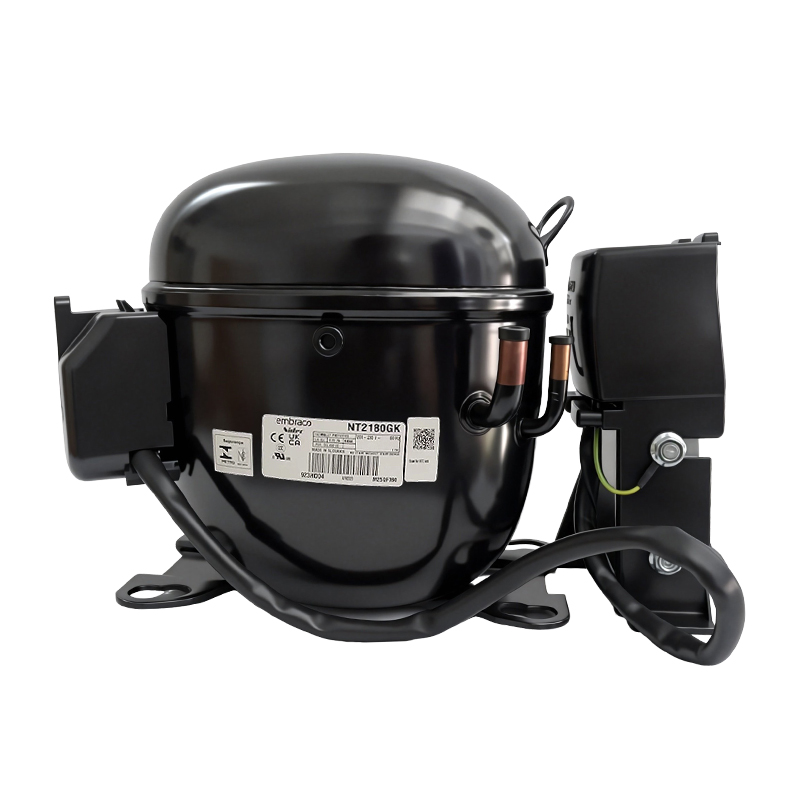
Embraco NEK2134GK Refrigeration Compressor

Embraco NEK2134GK Refrigeration Compressor: R-404A LBP Technical Data and Selection Guide
The Embraco NEK2134GK is a single-phase, 220-240 V 50 Hz hermetic reciprocating compressor rated for low back pressure (LBP) R-404A duty. It displaces 8.77 cm3 and reaches 464 W of cooling capacity at the ASHRAELBP32 check point (evaporating -23.3 C, condensing 54.4 C), at a coefficient of performance of 1.30 W/W.
By AUTHOR_NAME, AUTHOR_JOB_TITLE. Published YYYY-MM-DD. Updated YYYY-MM-DD.
What Is the Embraco NEK2134GK?
The NEK2134GK is a fixed-speed hermetic reciprocating compressor in the Embraco Aspera NE family, built in Slovakia and sold worldwide for commercial low-temperature refrigeration. It runs on R-404A at 220-240 V and 50 Hz, uses a CSIR motor with high starting torque, and spans an evaporating temperature range of -40 C to -10 C. Its published commercial designation is 1/2 hp. Inside the supplier's Embraco Aspera compressor range it sits at the small end of the low back pressure group, one displacement step above NEK2125GK.
The model suits systems that need a small, low-cost, fan-cooled compressor for frozen and chilled product at medium commercial scale: reach-in freezers, ice machines, beverage and drinking water coolers, dehumidifiers, and similar LBP equipment.
Everything in this guide is drawn from manufacturer-issued documents. Two of them matter most. The first is the technical data sheet numbered 958AA51, which rates the compressor on the ASHRAELBP32 check point. The second is the sheet numbered 958AA54, which rates the same compressor to EN 12900. They disagree on the headline capacity by 89 percent, and understanding why is the single most important thing a buyer can take from this page.
Key facts at a glance
| Item | Value | Basis |
|---|---|---|
| Model | NEK2134GK | Manufacturer technical data sheet, designation field |
| Compressor type | Hermetic reciprocating | Manufacturer sheet, application section 1 |
| Refrigerant | R-404A | Manufacturer sheet, application section 2 |
| Nominal voltage and frequency | 220-240 V, 50 Hz, single phase | Manufacturer sheet, application section 3 |
| Application envelope | LBP, Low Back Pressure R404A | Manufacturer sheet, application section 4 |
| Evaporating temperature range | -40 C to -10 C | Manufacturer sheet, application section 4.1 |
| Displacement | 8.77 cm3 (0.535 cu in) | Manufacturer sheet, mechanical section 2 |
| Commercial designation | 1/2 hp | Manufacturer sheet, mechanical section 1 |
| Motor type | CSIR, 2 pole, 1 phase | Manufacturer sheet, application section 5 |
| Starting torque class | HST, high starting torque | Manufacturer sheet, application section 6 |
| Cooling capacity, check point | 464 W (1584 Btu/h) | Manufacturer sheet, check point section, at -23.3 C evaporating and 54.4 C condensing |
| Cooling capacity, EN 12900 rated point | 245 W | Manufacturer EN 12900 sheet, rated points, at -35 C evaporating and 40 C condensing |
| Efficiency, check point | 1.30 W/W | Manufacturer sheet, check point section |
| Efficiency, EN 12900 rated point | 0.97 W/W | Manufacturer EN 12900 sheet, rated points |
| Oil charge and type | 350 ml, ester ISO22 | Manufacturer sheet, mechanical section 3 |
| Weight with oil | 11 kg | Manufacturer sheet, mechanical section 4 |
| Origin plant | Slovakia | Manufacturer EN 12900 sheet, general data |
| Locked rotor current | 16.10 A to UL 984 | Manufacturer sheet, electrical section 8 |
The two capacity rows are not a contradiction to be resolved by arithmetic. They are two different rating bases applied to one machine, and both are correct within their own conditions.
How do you read the NEK2134GK model code?
Embraco model strings are positional. The letters and digits encode family, displacement, refrigerant envelope, motor design and revision. The table below decodes each block of NEK2134GK against what the manufacturer documents confirm, and marks the blocks that the documents do not explain.
| Block | Value in NEK2134GK | What the manufacturer documents confirm | Status |
|---|---|---|---|
| Series prefix | NE | Low-temperature (LBP) platform in the Aspera NE family, R-404A generation | Confirmed by the ratio of LBP sheet entries to the LBP envelope declaration |
| Envelope letter | K | Used throughout the LBP R-404A 220-240 V catalogue section, alongside NEU, NT and NJ variants | Confirmed as a within-family variant marker |
| Displacement block | 2134 | Not a literal displacement. The catalogue prints 8.77 cm3 beside it, so the block is an ordinal, not centimetres cubed | Confirmed as non-literal |
| Suffix | GK | Applied to every model in the 220-240 V 50 Hz R-404A LBP catalogue section | Confirmed as a generation marker |
| Motor designation | CSIR | Capacitor start induction run, 2 pole, 1 phase | Confirmed by the electrical data section |
| Torque designation | HST | High starting torque | Confirmed by the application section |
The digits 2134 deserve a warning. Reading them as 21.34 cm3 would overstate the compressor by a factor of 2.4. The catalogue prints 8.77 cm3 for this model, and the manufacturer sheet confirms 8.77 cm3 in the mechanical data. Displacement must always be taken from the data table, never from the model string.
The same warning applies to the sibling ladder. NEU2140GK shares the 8.77 cm3 displacement with NEK2134GK, while NEK2150GK and NEU2155GK both step to 12.11 cm3. The ordinal block rises faster than the displacement does, so a buyer comparing on model number alone will misjudge the step sizes.
What Are the Technical Specifications of the NEK2134GK?
Application and operating limits
The manufacturer sheet lists the working limits that govern system design. The maximum condensing pressures are given as gauge pressures, and the winding temperature limit is the value used for motor protection setting.
| Limit | Value | Unit | Basis |
|---|---|---|---|
| Evaporating temperature range | -40 to -10 | C | Manufacturer sheet, application section 4.1 |
| Maximum condensing pressure, operating (gauge) | 25.7 (365 psig) | kgf/cm2 | Manufacturer sheet, application section 9.1 |
| Maximum condensing pressure, peak (gauge) | 28.7 (408 psig) | kgf/cm2 | Manufacturer sheet, application section 9.2 |
| Maximum winding temperature | 130 | C | Manufacturer sheet, application section 10 |
| Nitrogen holding charge | 0.2 to 0.3 | kgf/cm2 | Manufacturer sheet, mechanical section 5 |
| Expansion device | Capillary tube or expansion valve | - | Manufacturer sheet, application section 7 |
| Compressor cooling | Fan | - | Manufacturer EN 12900 sheet, general data |
| Technology | ON/OFF, fixed speed | - | Manufacturer EN 12900 sheet, general data |
Two notes belong with this table. First, the manufacturer sheet's own compressor cooling table, which sets out operating voltage ranges for LBP and HBP at 32 C and 43 C ambient, is printed with dashes in every cell of the retrieved copy, so the ambient-derived voltage ranges cannot be quoted from that sheet. The EN 12900 sheet states the cooling method as Fan and leaves the voltage-range question open. Second, the ON/OFF technology declaration is worth emphasising, because some third-party listings for this model copy marketing text referring to IDV technology. IDV is Embraco's variable-capacity mechanism, and this model is a fixed-speed ON/OFF machine. The claim does not apply here.
Mechanical data
| Parameter | Value | Unit | Basis |
|---|---|---|---|
| Commercial designation | 1/2 | hp | Manufacturer sheet, mechanical section 1 |
| Displacement | 8.77 (0.535 cu in) | cm3 | Manufacturer sheet, mechanical section 2 |
| Bore | 26.497 | mm | Manufacturer sheet, mechanical section 2.1 |
| Stroke | 7.960 | mm | Manufacturer sheet, mechanical section 2.2 |
| Stroke, as printed on the North American sheet | 15.92 (0.63 in) | mm | Manufacturer North American sheet, mechanical data |
| Lubricant charge | 350 (11.84 fl.oz.) | ml | Manufacturer sheet, mechanical section 3 |
| Lubricant type and viscosity | Ester, ISO22 | - | Manufacturer sheet, mechanical section 3.2 |
| Weight with oil charge | 11 (24.25 lb.) | kg | Manufacturer sheet, mechanical section 4 |
The two stroke figures are printed in two different manufacturer documents and differ by exactly a factor of two. Neither sheet declares the number of cylinders, and that missing piece decides which figure describes a single cylinder and which describes the total. The arithmetic runs like this. A bore of 26.497 mm gives a piston area of 551.4 mm2. Multiplying by the 7.960 mm stroke gives 4,389 mm3, or 4.389 cm3, which reaches the published 8.77 cm3 only if the compressor has two cylinders. Multiplying by the 15.92 mm stroke gives 8,778 mm3, or 8.778 cm3, which matches the published figure with a single cylinder. Because the documents are silent on cylinder count, this guide reports both figures and does not pick one.
Electrical data
| Parameter | Value | Unit | Basis |
|---|---|---|---|
| Nominal voltage, frequency, phases | 220-240 V, 50 Hz, 1 phase | - | Manufacturer sheet, electrical section 1 |
| Starting device type | Current relay | - | Manufacturer sheet, electrical section 2 |
| Start capacitor | 53-64 (330 VAC minimum) | uF | Manufacturer sheet, electrical section 3 |
| Run capacitor | None fitted | uF | Manufacturer sheet, electrical section 4 |
| External motor protection | T0168/G5 | - | Manufacturer sheet, electrical section 5 |
| Start winding resistance at 25 C | 31.70, plus or minus 8 percent | ohm | Manufacturer sheet, electrical section 6 |
| Run winding resistance at 25 C | 5.18, plus or minus 8 percent | ohm | Manufacturer sheet, electrical section 7 |
| Locked rotor amperage at 50 Hz | 16.10, measured to UL 984 | A | Manufacturer sheet, electrical section 8 |
| Full load amperage, L/MBP and HBP at 50 Hz | Not printed | A | Manufacturer sheet, electrical sections 9 and 10 |
| Approval boards certification | IMQ | - | Manufacturer sheet, electrical section 11 |
The absence of a run capacitor is a practical advantage. A CSIR motor with a start capacitor only needs one capacitor in the circuit, which reduces the component count and the number of failure points on the refrigeration unit. The start capacitor value of 53 to 64 uF at a 330 VAC minimum rating is the value to specify when ordering replacement parts.
The locked rotor amperage deserves a caution. The datasheet figure of 16.10 A is measured to UL 984. The manufacturer's own product catalogue prints 22.70 A in the LRA column for the same model and the same voltage section. The catalogue's LRA column is not reliable across the family, as the comparison section of this guide shows, so the datasheet value is the one to use for circuit protection sizing.
External connections and installation envelope
| Feature | Value | Unit | Basis |
|---|---|---|---|
| Base plate | European Standard | - | Manufacturer sheet, external characteristics section 1 |
| Base plate, as printed on the EN 12900 sheet | Small | - | Manufacturer EN 12900 sheet, external characteristics |
| Tray holder | No | - | Manufacturer sheet, external characteristics section 2 |
| Tray holder, as printed on the EN 12900 sheet | Yes | - | Manufacturer EN 12900 sheet, external characteristics |
| Suction connector | 8.1, with plus 0.10 and minus 0.00 tolerance | mm | Manufacturer sheet, external characteristics section 3.1 |
| Suction connector material and shape | Copper, slanted 42 degrees | - | Manufacturer sheet, external characteristics sections 3.1.1 and 3.1.2 |
| Discharge connector | 6.1, with plus 0.10 and minus 0.00 tolerance | mm | Manufacturer sheet, external characteristics section 3.2 |
| Discharge connector material and shape | Copper, straight | - | Manufacturer sheet, external characteristics sections 3.2.1 and 3.2.2 |
| Process connector | 6.1, with plus 0.10 and minus 0.00 tolerance | mm | Manufacturer sheet, external characteristics section 3.3 |
| Process connector material and shape | Copper, slanted 42 degrees | - | Manufacturer sheet, external characteristics sections 3.3.1 and 3.3.2 |
| Oil cooler | None | - | Manufacturer sheet, external characteristics section 3.4 |
| Connector sealing | Rubber plugs | - | Manufacturer sheet, external characteristics section 3.5 |
| Overall length, drawing dimension C | 242 | mm | Manufacturer North American sheet, dimensions |
| Shell width, drawing dimension B | 162 | mm | Manufacturer North American sheet, dimensions |
| Overall height, drawing dimension A | 7.9 in, approximately 201 | mm | Manufacturer North American sheet, dimensions |
Two of these rows disagree between the two manufacturer sheets: base plate and tray holder. The 220-240 V sheet calls the base plate European Standard and says there is no tray holder. The EN 12900 sheet calls the base plate Small and says a tray holder is fitted. Both documents carry the same model designation, and this guide reports both rather than choosing, because the difference matters if a buyer is matching an existing mounting pattern or planning a condensate path.
The connector dimensions are the values to use for brazing preparation. Suction is 8.1 mm copper slanted at 42 degrees, discharge is 6.1 mm copper straight, and the process stub is 6.1 mm copper slanted at 42 degrees. The North American sheet gives the same three tubes in inches, as 0.316 in for suction and 0.254 in for discharge and process, which converts to 8.03 mm and 6.45 mm. The small differences between the two sheets suggest different measurement points rather than different parts, but the metric sheet is the one to follow for a 220-240 V unit.
What Cooling Capacity Does the NEK2134GK Produce?
Two manufacturer documents describe the cooling capacity of this model, and they do not agree. One gives 464 W and the other gives 245 W. A buyer who reads only one of them will size the system wrongly, so both numbers need to be on the table together, each with its own rating conditions.
Why two Embraco datasheets give two different capacities
Embraco publishes compressor performance on more than one rating basis. The American market convention, referenced on the sheets as ASHRAELBP32, fixes the compressor in a 32 C ambient with the evaporating and condensing temperatures chosen to represent a severe low-temperature duty point. The European convention, set out in EN 12900, fixes a 35 C ambient around the compressor and requires a stated suction condition and subcooling value so that different manufacturers' products can be compared on equal terms. A single compressor therefore carries two entirely legitimate capacity figures, and neither is wrong.
The practical consequence is that capacity numbers must never be compared across bases. The gap between the two figures recorded here is 89 percent, which is far larger than any real disagreement about the machine. Most of that gap is simply the difference between rating at -35 C evaporating and 40 C condensing on the one hand, and rating at -23.3 C evaporating and 54.4 C condensing on the other. An 11.7 K warmer evaporator and a 14.4 K cooler condenser are two very different operating points.
A cleaner way to see the real disagreement is to compare both sheets at the same conditions. Both documents carry a performance set at 35 C condensing. At -35 C evaporating, the ASHRAELBP32 sheet gives 293 W and the EN 12900 sheet gives 270 W. At -40 C evaporating they give 225 W and 200 W. The residual difference is between 8 and 11 percent, which reflects different test superheat and subcooling assumptions rather than different hardware.
The ASHRAELBP32 check point
This is the figure the 220-240 V technical data sheet presents as the headline performance for the model.
| Parameter | Value | Unit | Basis |
|---|---|---|---|
| Test condition | ASHRAELBP32, 220 V, 50 Hz, fan cooled | - | Manufacturer sheet, check point header |
| Evaporating temperature | -23.3 (-9.94) | C (F) | Manufacturer sheet, check point header |
| Condensing temperature | 54.4 (129.92) | C (F) | Manufacturer sheet, check point header |
| Cooling capacity | 464 | W | Manufacturer sheet, check point table |
| Cooling capacity | 1584 | Btu/h | Manufacturer sheet, check point table |
| Cooling capacity | 399 | kcal/h | Manufacturer sheet, check point table |
| Power consumption | 358 | W | Manufacturer sheet, check point table |
| Current consumption | 2.35 | A | Manufacturer sheet, check point table |
| Gas flow rate | 10.74 | kg/h | Manufacturer sheet, check point table |
| Efficiency rate | 1.30 | W/W | Manufacturer sheet, check point table |
| Efficiency rate | 4.42 | Btu/Wh | Manufacturer sheet, check point table |
| Efficiency rate | 1.11 | kcal/Wh | Manufacturer sheet, check point table |
| Stated tolerance, capacity and power | plus or minus 5 percent | - | Manufacturer sheet, check point header |
| Stated tolerance, efficiency | plus or minus 7 percent | - | Manufacturer sheet, check point header |
The three capacity columns and the three efficiency columns agree with each other under standard conversion. Dividing 464 W of capacity by 358 W of input gives 1.296, which rounds to the printed 1.30 W/W. That internal check holds on every row of every performance table in both documents, which is the reason the figures in this guide can be relied on.
The EN 12900 rated point
The European-rated sheet gives one rated point plus three curve sets. Its stated test conditions are worth reading closely, because they define exactly what the 245 W figure means.
| Parameter | Value | Unit | Basis |
|---|---|---|---|
| Tested standard | EN 12900 | - | Manufacturer EN 12900 sheet, tested conditions |
| Tested voltage and frequency | 220 V, 50 Hz | - | Manufacturer EN 12900 sheet, tested conditions |
| Tested cooling | Fan | - | Manufacturer EN 12900 sheet, tested conditions |
| Refrigerant temperature basis | Dew | - | Manufacturer EN 12900 sheet, tested conditions |
| Stated subcooling | 0 | K | Manufacturer EN 12900 sheet, test condition note |
| Stated return gas temperature | 20 | C | Manufacturer EN 12900 sheet, test condition note |
| Evaporating temperature | -35 | C | Manufacturer EN 12900 sheet, rated points |
| Condensing temperature | 40 | C | Manufacturer EN 12900 sheet, rated points |
| Cooling capacity | 245 | W | Manufacturer EN 12900 sheet, rated points |
| Power consumption | 252 | W | Manufacturer EN 12900 sheet, rated points |
| Efficiency | 0.97 | W/W | Manufacturer EN 12900 sheet, rated points |
| Gas flow rate | 6.62 | kg/h | Manufacturer EN 12900 sheet, rated points |
Two details in that table are easy to miss and both matter. The refrigerant temperature basis is dew, not mean, which is the correct convention for a zeotropic blend such as R-404A. The subcooling is fixed at 0 K, which matches the figure EN 12900 specifies for subcritical operation. The sheet also carries the manufacturer's own caveat, printed under each table, that the data are an indication of performance based simulation.
The rated point is internally consistent with the curves that follow it. Averaging the sheet's own 35 C and 45 C condensing curves at -35 C evaporating gives 245 W of capacity, 251 W of input and 6.615 kg/h of gas flow, against the printed 245 W, 252 W and 6.62 kg/h. A 40 C condensing rating sitting exactly midway between the 35 C and 45 C curves is what a properly built dataset should look like.
Which capacity figure should a buyer quote?
Quote the figure that matches the basis your specification uses, and say which basis it is. For a European tender or a specification written around EN 12900, use 245 W at -35 C evaporating and 40 C condensing. For a North American or general commercial refrigeration specification written around ASHRAE conventions, use 464 W at -23.3 C evaporating and 54.4 C condensing. For a real system design, use neither, and read the curve table for the actual evaporating and condensing temperatures the installation will run at.
How Does the NEK2134GK Perform Across Its Envelope?
The published curves let a system designer read capacity and efficiency at any point inside the envelope. Three condensing temperatures are tabulated on the 220-240 V sheet. The tables below reproduce the cooling capacity, power consumption, current, gas flow and efficiency for each evaporating temperature.
Performance at 35 C condensing
| Evaporating C | Capacity W | Input W | Current A | Gas flow kg/h | Efficiency W/W |
|---|---|---|---|---|---|
| -40 | 225 | 224 | 2.01 | 5.16 | 1.00 |
| -35 | 293 | 255 | 2.05 | 6.73 | 1.15 |
| -30 | 380 | 285 | 2.12 | 8.77 | 1.33 |
| -25 | 487 | 316 | 2.20 | 11.28 | 1.54 |
| -20 | 613 | 346 | 2.30 | 14.29 | 1.77 |
| -15 | 759 | 376 | 2.41 | 17.81 | 2.02 |
| -10 | 925 | 406 | 2.53 | 21.84 | 2.28 |
Basis: manufacturer technical data sheet, performance curves, test condition ASHRAE32 at 220 V 50 Hz, fan cooled, condensing temperature 35 C.
Performance at 45 C condensing
| Evaporating C | Capacity W | Input W | Current A | Gas flow kg/h | Efficiency W/W |
|---|---|---|---|---|---|
| -40 | 203 | 222 | 1.98 | 4.66 | 0.92 |
| -35 | 269 | 257 | 2.05 | 6.18 | 1.05 |
| -30 | 353 | 293 | 2.14 | 8.14 | 1.21 |
| -25 | 457 | 329 | 2.25 | 10.57 | 1.38 |
| -20 | 579 | 367 | 2.38 | 13.46 | 1.58 |
| -15 | 719 | 405 | 2.52 | 16.84 | 1.78 |
| -10 | 879 | 444 | 2.67 | 20.71 | 1.98 |
Basis: manufacturer technical data sheet, performance curves, test condition ASHRAE32 at 220 V 50 Hz, fan cooled, condensing temperature 45 C.
Performance at 55 C condensing
This is the set that reproduces the two figures printed for the model in the manufacturer's own product catalogue, 327 W at -30 C and 427 W at -25 C. That agreement is what identifies 55 C as the condensing basis behind the catalogue row.
| Evaporating C | Capacity W | Input W | Current A | Gas flow kg/h | Efficiency W/W |
|---|---|---|---|---|---|
| -40 | 182 | 220 | 1.95 | 4.15 | 0.83 |
| -35 | 245 | 259 | 2.05 | 5.63 | 0.95 |
| -30 | 327 | 300 | 2.17 | 7.52 | 1.09 |
| -25 | 427 | 343 | 2.31 | 9.85 | 1.24 |
| -20 | 544 | 388 | 2.46 | 12.63 | 1.40 |
| -15 | 679 | 434 | 2.63 | 15.87 | 1.57 |
| -10 | 833 | 482 | 2.81 | 19.58 | 1.73 |
Basis: manufacturer technical data sheet, performance curves, test condition ASHRAE32 at 220 V 50 Hz, fan cooled, condensing temperature 55 C.
The efficiency column shows the pattern a designer should plan around. At 55 C condensing the compressor is below 1.0 W/W everywhere colder than -30 C evaporating and only reaches 1.73 W/W at -10 C. At 35 C condensing the same machine reaches 2.28 W/W at -10 C. Condensing temperature control is therefore worth more to system efficiency on this model than any other single variable.
Performance curves on the EN 12900 basis
The European-rated sheet tabulates the same three condensing temperatures on its own basis. Because the suction condition differs from the ASHRAE convention, these figures sit below the ones above and are not interchangeable with them.
| Evaporating C | Capacity W, 35 C condensing | Capacity W, 45 C condensing | Capacity W, 55 C condensing |
|---|---|---|---|
| -40 | 200 | 162 | Not printed |
| -35 | 270 | 220 | Not printed |
| -30 | 356 | 292 | 228 |
| -25 | 460 | 380 | 298 |
| -20 | 580 | 481 | 380 |
| -15 | 715 | 596 | 474 |
| -10 | 866 | 725 | 580 |
Basis: manufacturer EN 12900 sheet, performance curves at 220 V 50 Hz, fan cooled, dew basis, subcooling 0 K, return gas 20 C.
The head-to-head at 55 C condensing, where both sheets publish, shows how consistent the offset is. Against the ASHRAE32 set the EN 12900 set runs 43.4 percent lower at -30 C, 43.3 percent lower at -25 C, 43.2 percent lower at -20 C and -15 C, and 43.6 percent lower at -10 C. A near-constant offset across the envelope means the two datasets describe the same machine and differ only in rating convention. It is also the fastest way to check that a quoted number has been taken from the sheet the seller claims.
What happens at 60 Hz?
Embraco also publishes this model for 115 V and 60 Hz, and that sheet gives a measured performance table at the same 54.4 C condensing temperature as the 50 Hz check point. The comparison mixes both voltage and frequency, so it is not a clean frequency test, but frequency dominates capacity on a reciprocating compressor and the figures are instructive.
| Evaporating C | Capacity at 60 Hz, W | Capacity at 50 Hz, W | Difference | Input at 60 Hz, W | Input at 50 Hz, W |
|---|---|---|---|---|---|
| -30 | 402 | 327 | plus 22.9 percent | 362 | 300 |
| -23.3 | 571 | 467 | plus 22.3 percent | 433 | 358 |
| -20 | 667 | 544 | plus 22.6 percent | 471 | 388 |
| -15 | 828 | 679 | plus 21.9 percent | 526 | 434 |
| -10 | 1007 | 833 | plus 20.9 percent | 581 | 482 |
Basis: the 60 Hz capacity and input columns are converted from the manufacturer North American sheet's LBP performance table, which prints capacity in Btu/h and kcal/h and power in watts. The 50 Hz columns are the 55 C condensing set from the 220-240 V sheet. The -23.3 C row for the 50 Hz machine is interpolated between its -25 C and -20 C values, and is labelled here as a derived figure.
The 60 Hz machine delivers roughly 21 to 23 percent more cooling capacity from the same displacement, at roughly 20 percent more motor input. A buyer choosing between a 50 Hz and a 60 Hz build of this compressor is choosing about a fifth more capacity, not a different class of machine.
What Is the Operating Envelope and What Applications Does It Suit?
Envelope limits
The compressor may be applied anywhere inside the published envelope. Outside it, the limits are set by winding temperature, maximum condensing pressure and oil behaviour, not by the printed capacity tables.
| Envelope boundary | Limit | Basis |
|---|---|---|
| Evaporating temperature, cold end | -40 C | Manufacturer sheet, application section 4.1 |
| Evaporating temperature, warm end | -10 C | Manufacturer sheet, application section 4.1 |
| Condensing temperature, envelope top at -40 C evaporating | approximately 45 C | Manufacturer EN 12900 sheet, envelope diagram |
| Condensing temperature, envelope top from about -30 C evaporating | approximately 55 C | Manufacturer EN 12900 sheet, envelope diagram |
| Transient condition ceiling | approximately 60 C | Manufacturer EN 12900 sheet, envelope diagram |
| Maximum operating condensing pressure, gauge | 25.7 kgf/cm2, 365 psig | Manufacturer sheet, application section 9.1 |
| Maximum peak condensing pressure, gauge | 28.7 kgf/cm2, 408 psig | Manufacturer sheet, application section 9.2 |
| Maximum winding temperature | 130 C | Manufacturer sheet, application section 10 |
The envelope diagram on the EN 12900 sheet is worth reading before any selection is fixed. It shows a narrowing envelope: at -40 C evaporating the condensing ceiling is around 45 C, and the ceiling only opens to about 55 C once the evaporating temperature has risen above roughly -30 C. A system designed for a deep-frozen evaporator in a hot plant room can therefore fall outside the envelope even though both the evaporating and condensing temperatures look acceptable in isolation. A separate transient band, drawn to about 60 C, marks conditions the compressor can survive temporarily but that should not be treated as continuous duty.
Applications the manufacturer lists
The manufacturer's North American data sheet carries a usage list for this model. It is the clearest available statement of what the compressor is intended for.
| Application | Why the NEK2134GK fits | Manufacturer statement |
|---|---|---|
| Drinking water coolers | Small LBP load, continuous duty, low noise expectation | Listed under Usage |
| Dehumidifiers | Cold evaporator with moderate capacity demand | Listed under Usage |
| Ice machines | Low evaporating temperature, cyclic load | Listed under Usage |
| Reach-in refrigerators | Commercial frozen storage with limited cabinet volume | Listed under Usage |
| Beer coolers | Chilled beverage duty with a small compressor footprint | Listed under Usage |
Basis: manufacturer North American sheet, Usage box, which also states Approximate H.P. 1/2, Starting Torque High, Refrigerant 404A, Evaporator Temperature Low, and an evaporator temperature span of -40 F to 14 F.
That list overlaps with the applications Embraco groups on its own website. Drinking water equipment is a named category in the manufacturer's application navigation, which makes the drinking water entry on the usage list a direct match rather than a general claim.
Alongside those, the model suits any commercial LBP duty that needs roughly 200 to 460 W of cooling capacity depending on the rating basis and operating point. That range covers small display freezers, under-counter frozen storage, condensing units assembled around this compressor, and the low-temperature end of catering refrigeration. One distributor publishes a factory-assembled model designated UNEK2134GK, which is the same compressor supplied inside a condensing unit. A separate NEK2134GK refrigerator compressor guide covers the same model from the appliance side.
Where the NEK2134GK is not the right choice
Some duties sit outside what this compressor is built for, and fitting it would either fail early or fail to hold temperature. The table below sets out the exclusions and the size of the mismatch.
| Duty | Why the NEK2134GK does not fit | What to look at instead |
|---|---|---|
| High back pressure or air conditioning duty | The model is declared LBP. Its warm envelope limit is -10 C evaporating, far below what HBP or MBP duty requires | An MBP or HBP model from the same catalogue |
| Capacity above roughly 1 kW at the design point | Displacement is 8.77 cm3, the second smallest in the 220-240 V R-404A LBP section | A larger displacement sibling such as NT2212GK or NJ2212GK |
| Variable-capacity or inverter duty | The compressor is a fixed-speed ON/OFF machine with a CSIR motor | A variable-speed Embraco model |
| Deep-frozen duty colder than -40 C evaporating | Outside the declared evaporating range | A compressor with a lower declared range |
| Installations classified as exclusively industrial | The harmonised motor-compressor safety standard excludes equipment designed exclusively for industrial use | A compressor and a safety route intended for industrial plant |
How Does the NEK2134GK Compare With Sibling Embraco Compressors?
The manufacturer's own product catalogue places this model in a single section headed 220-240 V, 50 Hz, R-404A, LBP. Every model in that section shares the refrigerant, the voltage, the frequency and the envelope, which makes the section the cleanest available comparison group. The table below reproduces the rows for which the catalogue prints cooling capacity.
| Model | Origin | Displacement cm3 | Torque | Motor | LRA A | Capacity at -30 C, W | Capacity at -25 C, W |
|---|---|---|---|---|---|---|---|
| NEK2134GK | SK | 8.77 | HST | CSIR | 22.70 | 327 | 427 |
| NEU2140GK | SK | 8.77 | HST | CSR NTC, CSCR | Not printed, 22.00 | 341 | 446 |
| NEK2150GK | SK | 12.11 | HST | CSIR | 21.00 | 436 | 562 |
| NEU2155GK | SK | 12.11 | HST | CSCR | 35.00 | 460 | 601 |
| NEU2168GK | SK | 14.28 | HST | Not printed | Not printed | 523 | 682 |
| NEU2178GK | SK | 16.80 | HST | Not printed | Not printed | 643 | 831 |
| NT2180GKV | SK | 20.44 | HST | Not printed | Not printed | 646 | 855 |
| NT2192GK | SK | 22.37 | HST | Not printed | Not printed | 726 | 960 |
| NT2210GK | SK | 26.21 | HST | Not printed | Not printed | 640 | 839 |
| NT2212GK | SK | 27.80 | HST | Not printed | Not printed | 965 | 1265 |
| NJ2212GK | SK | 34.38 | HST | Not printed | Not printed | 1040 | 1403 |
| NJX2219GK | SK | 38.00 | HST | Not printed | Not printed | 824 | 1094 |
Basis: manufacturer product catalogue, section 220-240 V 50 Hz, R-404A, LBP, ASHRAELBP32 test condition. Capacity columns are the -30 C and -25 C evaporating columns, which are the two columns the catalogue prints for most rows in this section. All displacement values are the catalogue's own.
What the comparison shows
The displacement steps are not uniform and the capacity steps are not proportional. Moving from NEK2134GK to NEU2168GK adds 5.51 cm3 of displacement and about 60 percent more capacity at -30 C, and going on to NEU2178GK roughly doubles the output of the target model. The largest jump in the section is reserved for the NJ family, where displacement more than triples and capacity reaches 1,040 W at -30 C against 327 W, a gain of about 218 percent.
Two rows in that ladder break the pattern and should be treated with caution. NT2210GK lists a larger displacement than NT2192GK, 26.21 cm3 against 22.37 cm3, yet prints a lower capacity, 640 W against 726 W at -30 C. NJX2219GK does the same against NJ2212GK, printing 824 W from 38.00 cm3 where the smaller model prints 965 W from 27.80 cm3. Either the catalogue rows are transposed or those two models are rated on a different basis. This guide does not resolve which, and a buyer considering either model should request the model-specific datasheet before committing.
The same caution applies to the locked rotor amperage column, which the catalogue prints only for the smaller models. Where it is printed, the values are not internally consistent: the table above shows 35.00 A against a 12.11 cm3 model, while the wider section prints 37.50 A against a 5.19 cm3 model in the same group. Locked rotor amperage should be taken from the model datasheet, which gives 16.10 A for the NEK2134GK measured to UL 984.
Motor designations across the family
The catalogue marks each row with a motor designation. The table records what the designations are and what the source documents actually confirm about them.
| Designation | Meaning as used by the manufacturer | Evidence in the source documents |
|---|---|---|
| CSIR | Capacitor start induction run. Used by NEK2134GK and several NEK and NT siblings | The electrical data section confirms the two components that define this motor: a 53 to 64 uF start capacitor and a current relay starting device |
| CSCR | Capacitor start capacitor run. Used by NEU2155GK, NEU2140GK and the EHU models | The catalogue prints the designation only. The EN 12900 sheet for this model states No against the CSR CSIR box, but that field refers to an ancillary box, not the motor type |
| CSR NTC | Printed against one NEU2140GK row | Not expanded anywhere in the retrieved documents |
| HST | High starting torque | Confirmed by the application section, which names high starting torque |
Every row in the 220-240 V R-404A LBP section carries the HST torque marking, so torque class is not a differentiator inside this group. Motor type is: NEK2134GK is a CSIR machine with no run capacitor, while the NEU2155GK and EHU listings are CSCR and therefore carry a run capacitor as well.
The same model at other voltages and frequencies
The manufacturer publishes NEK2134GK for more than one supply. This matters when a buyer is matching an existing installation or sourcing a replacement, because the same model number alone does not fix the electrical build.
| Supply | Motor | Start capacitor | LRA as printed | Capacity at -30 C | Source and note |
|---|---|---|---|---|---|
| 220-240 V, 50 Hz | CSIR | 53 to 64 uF at 330 VAC minimum | 16.10 A to UL 984 | 327 W | Technical data sheet, and catalogue capacity column |
| 115-127 V, 60 Hz | CSCR | 189 to 227 uF at 165 V | 44.00 A in the catalogue, 37.5 A on the model sheet | 402 W | Catalogue row plus the North American sheet |
| 100 V, 50 or 60 Hz | Not printed | Not printed | Listed for the model | Printed for two frequency columns | Catalogue 100 V section |
Two conflicts are visible in that table and neither can be resolved from the documents. The locked rotor amperage for the 115-127 V build is printed as 44.00 A by the catalogue and 37.5 A by the model sheet. The start capacitor also changes with voltage, from 53 to 64 uF at 220-240 V to 189 to 227 uF at 115 V, which is expected for a lower supply voltage but means that parts are not interchangeable between builds. Always confirm the electrical build from the unit label rather than from the model number.
Is R-404A Still a Workable Choice for the NEK2134GK?
R-404A is a high-GWP hydrofluorocarbon blend. It remains technically excellent for low-temperature commercial refrigeration, and it is also the refrigerant that European regulation has moved against most aggressively. A buyer in Europe needs to understand the position before ordering, and a buyer outside Europe needs to understand it because the same rules shape supply and service across the chain.
What R-404A is
| Property | Value | Basis |
|---|---|---|
| Composition | HFC-125 at 44 percent, HFC-134a at 4 percent, HFC-143a at 52 percent | German Environment Agency GWP table, R-404A row |
| GWP, IPCC fourth assessment | 3922 | German Environment Agency GWP table |
| GWP, IPCC fifth assessment | 3943 | German Environment Agency GWP table |
| GWP as used by Regulation (EU) 2024/573 | 3922 | German Environment Agency GWP table, F-gas regulation column |
| Temperature basis for rating | Dew, reflecting the blend's glide | Manufacturer EN 12900 sheet, tested conditions |
To put the figure in context, the same source lists R-407A at 2107, R-407B at 2804 and R-407C at 1774. R-404A is therefore roughly twice as high as the common R-407 family alternatives and is the highest of that group.
Where Regulation (EU) 2024/573 places it
The regulation prohibits the placing on the market of certain equipment containing high-GWP fluorinated greenhouse gases. Three entries matter for equipment built around this compressor.
| Provision | Equipment | Refrigerant condition | Applies from |
|---|---|---|---|
| Annex IV item 3(a) | Refrigerators and freezers for commercial use, self-contained equipment | HFCs with GWP of 2500 or more | 1 January 2020 |
| Annex IV item 3(c) | Refrigerators and freezers for commercial use, self-contained equipment | Other fluorinated greenhouse gases with GWP of 150 or more | 1 January 2025 |
| Annex IV item 4 | Any self-contained refrigeration equipment, except chillers | Fluorinated greenhouse gases with GWP of 150 or more, unless required to meet safety requirements at the site of operation | 1 January 2025 |
Basis: Regulation (EU) 2024/573, Annex IV, as published in the Official Journal. The regulation defines self-contained equipment in Article 2(9) as a complete factory-made system in a suitable frame or casing, fabricated and transported complete or in two or more sections, which can contain isolation valves and in which no gas-containing parts are connected on site.
A separate provision, Article 13(3), restricts the use of fluorinated greenhouse gases with a GWP of 2500 or more for the maintenance and servicing of refrigeration equipment from 1 January 2025. That provision was verified against the published regulation during an earlier project in this series and has not been re-opened in this revision; it should be re-checked against the current consolidated text before being used on its own as a compliance argument.
What the rules mean for NEK2134GK buyers
A self-contained commercial refrigerator or freezer built on R-404A has been outside the European placing-on-the-market rules since 1 January 2020 under item 3(a), because R-404A at a GWP of 3922 exceeds the 2500 threshold for HFCs. A self-contained refrigeration unit that is not a refrigerator or freezer fell under item 4 from 1 January 2025. For a European buyer, that means the compressor remains serviceable and legally usable in existing equipment, but a new self-contained product containing R-404A is not a compliant route to market.
For buyers outside Europe, the practical considerations are different but not absent. R-404A supply will tighten over time as European and other markets move to lower-GWP refrigerants, and the price of the refrigerant itself is likely to rise relative to alternatives. A buyer specifying R-404A equipment today should confirm that the equipment is intended for a market where R-404A remains permitted, and should plan the service and eventual replacement path at the same time as the purchase.
Where a buyer needs an alternative, the compressor range itself offers one: the manufacturer publishes the NEK series in an R-404A generation and also builds low-temperature models for other refrigerants in the same physical family. A buyer who plans to migrate should size the replacement on its own datasheet rather than assuming that the displacement carries across refrigerants, because capacity per cubic centimetre differs substantially between them.
Which Standards and Approvals Apply to the NEK2134GK?
Three groups of documents govern this compressor: the rating standard that determines how its performance must be presented, the safety standards that apply to the motor-compressor itself and to the appliances it goes into, and the refrigerant regulation that governs where equipment containing R-404A may be placed on the market.
Rating and safety standards
| Standard | Scope | Edition | Why it applies here | Source |
|---|---|---|---|---|
| EN 12900 | Refrigerant compressors: rating conditions, tolerances and presentation of performance data | 2025, approved by CEN on 10 February 2025, published 25 March 2025, supersedes the 2013 edition | It is the standard the manufacturer's 958AA54 sheet declares, and it defines the conditions behind the 245 W rated point | EN 12900:2025 catalogue entry |
| EN 13771-1 | Compressors and condensing units for refrigeration: performance testing and test methods | 2016 | EN 12900 requires published performance to be based on tests performed to this standard | EN 12900:2025 catalogue entry, related standards |
| IEC 60335-2-34 | Household and similar electrical appliances, safety, particular requirements for motor-compressors | Edition 7.0, published 20 November 2024 | It is the harmonised safety standard for sealed motor-compressors with a rated voltage up to 250 V single phase, which covers this model | IEC webstore publication 80533 |
| IEC 60335-2-89 | Safety of commercial refrigerating appliances and ice-makers | Edition 3.0, published 20 June 2019 | Applies to the commercial refrigeration appliances this compressor is built into | IEC webstore publication 62243 |
| IEC 60335-2-40 | Safety of electrical heat pumps, air conditioners and dehumidifiers | 2022 | Relevant to the dehumidifier applications on the manufacturer's usage list | IECEE standard page |
| ISO 5149-1 | Refrigerating systems and heat pumps: safety and environmental requirements | 2014 | Sets the system-level safety framework around the compressor | ISO standard page 54979 |
| ISO 817 | Refrigerants: designation and safety classification | Referenced by the standards above | Defines how R-404A is designated and classified | Listed as a normative reference in IEC 60335-2-34 |
| UL 984 | Hermetic refrigerant motor-compressors | Basis of the printed locked rotor amperage | The manufacturer states the 16.10 A figure is measured according to this standard | Manufacturer sheet, electrical section 8 |
One point about IEC 60335-2-34 deserves emphasis. The standard states explicitly that it does not apply to motor-compressors designed exclusively for industrial purposes. A compressor sold into commercial refrigeration falls inside the standard; the same compressor in an installation classified as exclusively industrial falls outside it, and a different safety route applies. This is a classification decision for the system builder, not for the compressor supplier.
What EN 12900 does and does not do
EN 12900 fixes how compressor performance must be rated and published so that products from different manufacturers can be compared. Its scope is the rating conditions, the tolerances and the method of presenting performance data, and it applies to single-stage and two-stage compressor data with or without an additional intermediate pressure inlet. It also covers compressors used with R-744 in transcritical operation, and it includes requirements for presenting part-load data where those apply.
The standard does not set a minimum efficiency or a performance target. A compressor can be fully EN 12900 compliant and still be inefficient. What the standard gives a buyer is comparability, and that is where it earns its place in a specification. Among the conditions it fixes are an ambient of 35 C around the compressor and a subcooling value of 0 K for subcritical operation, along with defined suction superheat options that include plus 10 K for halocarbons and hydrocarbons and household application temperatures of plus 20 C and plus 32 C.
The 2025 edition replaced the 2013 edition and added an annex for calculating dew point and mean temperatures for refrigerants with glide. That annex matters for R-404A, which is a zeotropic blend, and it is why the manufacturer's EN 12900 sheet declares its refrigerant temperature basis as dew rather than mean.
The approval mark
The manufacturer's electrical data section declares IMQ as the approval board certification for this model. That is the only named approval recorded in the documents retrieved for this guide. The EN 12900 sheet also carries a band of three certification marks in its header, but the retrieved copy renders them as graphics that could not be resolved to named schemes, so no further approval claim is made here.
How Do You Select the NEK2134GK for a System?
Selection follows the same order for any LBP compressor. Working through the steps in sequence avoids the common failure of choosing a model on headline capacity and then discovering that the design point sits outside its envelope.
- Fix the evaporating temperature the system will hold. This sets the capacity row to read, and it must be a design value rather than an average. If the evaporator will run at -30 C, read the -30 C row and not the -25 C row.
- Fix the condensing temperature the plant will see at design ambient. This decides which of the three published curve sets applies. On this model the choice between 35 C and 55 C condensing changes capacity by more than 40 percent, so it is not a second-order decision.
- Confirm the design point sits inside the envelope. Check the evaporating temperature against the -40 C to -10 C range, then check the condensing ceiling for that evaporating temperature on the envelope diagram, and separately check it against the 25.7 kgf/cm2 operating pressure limit.
- Read capacity and input power from the correct table. Use the 50 Hz 220-240 V tables for a European build, and take efficiency from the same row rather than calculating it separately.
- Choose the rating basis and record it. If the specification is European, quote the EN 12900 figure at -35 C evaporating and 40 C condensing. If it follows ASHRAE conventions, quote the check point at -23.3 C evaporating and 54.4 C condensing. Put the basis in the specification document so the next person does not compare the two by mistake.
- Check the electrical supply and starting arrangement. This build needs 220-240 V at 50 Hz single phase, a 53 to 64 uF start capacitor rated at 330 VAC minimum, and a current relay. There is no run capacitor to allow for.
- Size the circuit protection from the datasheet locked rotor amperage of 16.10 A measured to UL 984, not from the catalogue column, which is inconsistent across the family.
- Confirm the mounting and piping details. The base plate and tray holder are described differently on the two manufacturer sheets, so match against the physical unit rather than either document. Plan for an 8.1 mm slanted suction connection and 6.1 mm discharge and process connections.
- Confirm the refrigerant route to market. Check whether R-404A equipment of the type being built may be placed on the market in the destination territory and from what date, then confirm the service and replacement plan.
Steps 3, 5 and 9 are the ones that cause the most rework when they are skipped, because each of them can invalidate a selection that looked correct at step 1. For screening candidate models against a required duty point, the manufacturer's fixed-speed reciprocating compressor range and its Product Selector are the natural starting points.
Frequently Asked Questions
What is the cooling capacity of the Embraco NEK2134GK?
The manufacturer publishes two figures on two different rating bases. The 220-240 V 50 Hz technical data sheet gives 464 W at the ASHRAELBP32 check point, with the evaporator at -23.3 C and the condenser at 54.4 C. The EN 12900 sheet gives 245 W at its rated point, with the evaporator at -35 C and the condenser at 40 C. Both are correct for their own conditions, and neither should be quoted without its rating basis.
Does the Embraco NEK2134GK need a run capacitor?
No. The model uses a CSIR motor, and the electrical data section records the run capacitor value as not fitted. Only a start capacitor is required, with a value of 53 to 64 uF at a minimum rating of 330 VAC. The starting device is a current relay, and external motor protection is provided by a T0168/G5 device.
Can the Embraco NEK2134GK be used with a refrigerant other than R-404A?
Every manufacturer document retrieved for this guide declares R-404A only, and R-404A is the refrigerant on which both published rating bases are built. One distributor lists the compressor against both R-404A and R-507A, but no manufacturer document confirms R-507A, and R-507A has different thermodynamic properties. A buyer intending to use an alternative refrigerant should obtain written confirmation from the manufacturer and a performance table for that refrigerant before selecting the model.
Is the Embraco NEK2134GK an inverter or variable-speed compressor?
No. The manufacturer's EN 12900 sheet states the technology as ON/OFF, and the motor is a single-phase CSIR machine with a current relay. The model is a fixed-speed compressor. Marketing text that associates variable-capacity IDV technology with this model does not apply, and the compressor's capacity can only be modulated by cycling it or by other system-level means.
What is the difference between the NEK2134GK and the NEU2140GK?
Both models displace 8.77 cm3 and both appear in the same 220-240 V 50 Hz R-404A LBP catalogue section, so they are the closest pair in the range. They differ in motor and in output: the NEK2134GK uses a CSIR motor and the catalogue prints 327 W at -30 C, while the NEU2140GK lists a CSR NTC and CSCR motor arrangement and prints 341 W at -30 C, about 4 percent more. For a buyer who needs the smallest step up without changing displacement, that pair is the comparison to make.
What voltage does the Embraco NEK2134GK require?
The build described in this guide requires 220-240 V at 50 Hz single phase. The same model number is also built for 115-127 V at 60 Hz and for 100 V at 50 or 60 Hz, with different motor arrangements and different start capacitors. The model number alone does not identify the electrical build, so the supply requirements must be confirmed from the unit label or the order specification.
Sources
- Embraco NEK2134GK compressor technical data, engineering number 958AA51, 220-240 V 50 Hz: technical data sheet held by Resluk
- Embraco NEK2134GK compressor technical data, engineering code 958AA54, EN 12900 basis: technical data sheet held by Hutes Klima Technika
- Embraco NEK2134GK North American technical data, 115 V 60 Hz, revision 10/12: technical data sheet held by Packard
- Embraco product catalogue, including the 220-240 V 50 Hz R-404A LBP section: official catalogue PDF
- Embraco fixed-speed reciprocating compressor range: manufacturer product family page
- Embraco Product Selector, described by the manufacturer as its official portfolio platform: product selector
- Embraco technical documentation centre: manufacturer documentation index
- Embraco drinking water equipment applications: manufacturer application category
- EN 12900:2025, Refrigerant compressors: rating conditions, tolerances and presentation of performance data: standard catalogue entry
- IEC 60335-2-34:2024, particular requirements for motor-compressors: IEC webstore
- IEC 60335-2-89:2019, commercial refrigerating appliances and ice-makers: IEC webstore
- IEC 60335-2-40:2022, electrical heat pumps, air conditioners and dehumidifiers: IECEE standard page
- ISO 5149-1:2014, refrigerating systems and heat pumps: ISO standard page
- Regulation (EU) 2024/573 on fluorinated greenhouse gases, including Annex IV: Official Journal text
- German Environment Agency, global warming potential values under Regulation 2024/573: GWP reference table
- European Commission, climate-friendly alternatives to F-gases in refrigeration: Commission guidance page
- UNEP and FAO, Sustainable food cold chains, 2022: research report
- Embraco Aspera compressor range on the supplier site: Embraco Aspera compressor group
- Embraco NEK2134GK product information on the supplier site: NEK2134GK compressor page
- Related product guide for this model: Embraco NEK2134GK refrigerator compressor
- Related guide to another fixed-speed Embraco compressor: Embraco FFU160UAX fixed-speed compressor
- Related Embraco refrigerator compressor article: Embraco compressor EMS6170Z
- Supplier category index for this compressor type: reciprocating compressor range
Embraco NT2180GK Refrigeration Compressor
Embraco Refrigerator Compressor EMS6170Z
Related Article