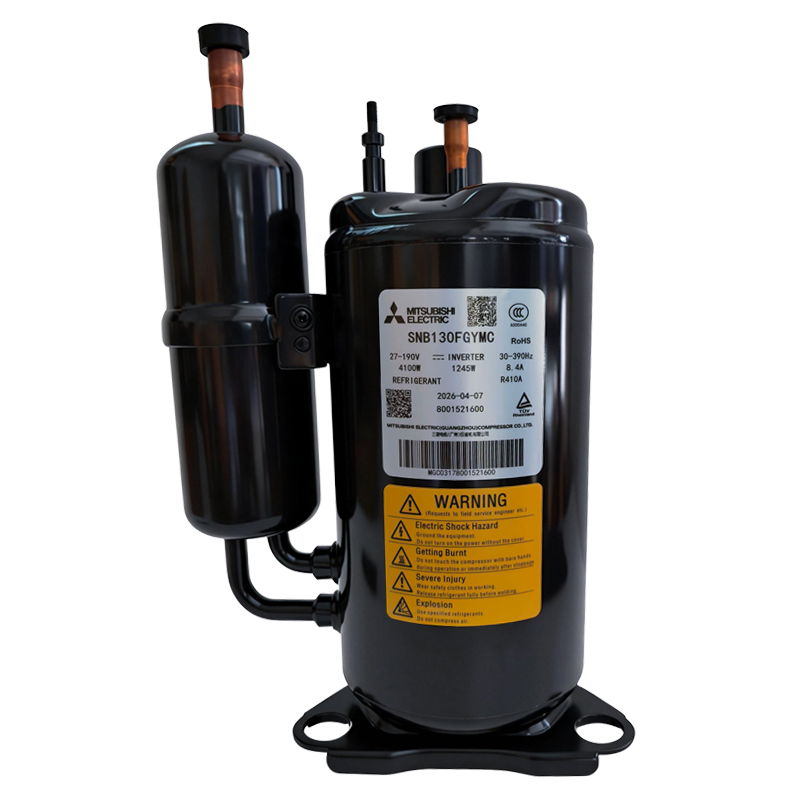
Mitsubishi MNB33FBDMC-L AC Refrigeration Compressors

Mitsubishi MNB33FBDMC-L R410A AC Rotary Compressor
Which outdoor units take it, and which take a smaller compressor
The same specification table puts five service references in five columns and one compressor model under each. Read position by position, the row runs as follows.
| Service ref | Compressor model printed |
|---|---|
| PUHZ-SP125VKA.TH | MNB33FBDMC-L |
| PUHZ-SP140VKA.TH | MNB33FBDMC-L |
| PUHZ-SP100YKA.TH | SNB220GBAMT |
| PUHZ-SP125YKA.TH | MNB33FBDMC-L |
| PUHZ-SP140YKA.TH | MNB33FBDMC-L |
The positional reading deserves a word, because a five-column table flattened into running text loses its columns and a careless reading will either drop the odd machine or attach it to the wrong unit. Two independent features of the page agree on the mapping. The compressor row carries exactly one entry that is not MNB33FBDMC-L, and it sits in third position. The service-reference row carries exactly one reference that is not an SP125 or an SP140, and it also sits in third position. One odd column in each row is far more likely to be the same column than a coincidence of ordering.
Read that way, MNB33FBDMC-L is the compressor of the SP125 and SP140 outdoor units, and the SP100 column takes a different, smaller machine. The size ordering is what a designer would predict: an SP100 sits a step below an SP125, and the machine under it carries an SNB220 designation rather than an MNB33 one. Distributor data for a sibling string in that class, SNB220FBGMC, prints 22.0 cm3/rev, so the SNB220 class is a materially smaller machine than the MNB33 class.
The test refrigerant is printed on the same table as R410A, and it is the only refrigerant named anywhere in the document. That single fact resolves a question that the shop's own pages leave open, because those pages never print a refrigerant word that is specific to a model rather than inherited from a class.
The row directly below the model row in the manual is the starter type, and it reads Direct input. That is worth recording without resolving. Every one of the 29 MNB pages in this shop describes its contents with the word Inverter, in the page title, in the URL slug and in the voltage field, while the manufacturer document for this exact string says Direct input in the row where a drive type would normally appear. This article does not claim that either usage is wrong. It records that the two documents describe the machine differently and that no document in reach reconciles them.
What the service manual settles, and what it does not
The specification table is a five-column matrix rendered across a spread, and the text layer of the document returns its cells in an order that preserves the values but not the column assignment. That is normal for this kind of page and it is easy to underestimate. The status of each item is set out below exactly as far as the document supports it.
| Item | Status in the manual |
|---|---|
| Compressor model in four of the five columns | printed, and assignable, because the odd column agrees on both rows |
| Refrigerant R410A | printed once for the whole table |
| Outdoor-unit service references | printed, five of them |
| Motor output per model | printed as a row, not assignable to a single column from the text layer |
| Oil charge per model | printed as a row, not assignable to a single column from the text layer |
| Maximum current per model | printed as a row, not assignable to a single column from the text layer |
| Swept volume | not printed anywhere in the manual |
| Rated cooling capacity | not printed |
| Rated power input | not printed |
| Voltage and phase of the compressor itself | not printed for the compressor, only for the outdoor unit supply |
A number that cannot be tied to its own column is not a specification. It is a guess wearing a table's clothes. For that reason this article prints no motor output, no oil charge and no current figure for MNB33FBDMC-L, even though all three rows exist on the page the model string was found on.
The rows that are missing are the ones a compressor buyer wants first. Swept volume, rated capacity and rated power input are the three fields that decide whether a machine will do a job, and the manufacturer document that proves the string exists is silent on all three. That silence is the central fact about this model, and everything else in the article follows from it.
The MNB33 block this shop publishes
Each MNB product page in this shop opens with a five-line numbered block, and the block is identical on all three of the MNB33 pages. It reads, in the page's own words:
1. Refrigerant Gas: R410A
2. Input: 3290W
3. Cooling capacity: 36952BTU/h
4. Voltage: INVERTER Compressor
5. Application: AC,drier,refrigeration,chiller,etc.
Line four puts a drive description in a voltage field, so the block never states a voltage at all. Line five is a template string, and it is the same string on every one of the 29 pages: air conditioning, drier, refrigeration, chiller, and an etc that covers whatever is left. For a compressor that the manufacturer's own manual fits to split-type heat pump outdoor units, the words drier and chiller have no support in any document in reach.
Further down the same page sits a Product Details table, and this one carries fields rather than a summary. On the MNB33 pages it reads as follows.
| Row | Printed value |
|---|---|
| Model | MNB33FEBMC |
| Displacement | 33.8 cm3/rev |
| Input | 3290W |
| Capacity | 10830W |
| Capacity, second line | 36952BTU/h |
| Refrigerant | R410A |
| Voltage | INVERTER Compressor |
| COP | 3.29W/W |
| Dimension | 334A/mm |
| Usage/Application | AC,drier,refrigeration,chiller,etc. |
Two things in that table are worth stopping on. The displacement field is the only swept volume figure available for this class anywhere in reach, and it is a self-published figure rather than a manufacturer one, so it carries the weight of a shop measurement and not the weight of a rating. And the Model row prints MNB33FEBMC, which is not the model this page is about. That second point is serious enough to have its own section below.
The classes are all filed under the Mitubishi Rotary Compressor category, and the category page is the correct landing point for a buyer who has arrived at a part number without a model.
Twenty-nine pages, five parameter blocks
Reading all 29 MNB pages in the shop and extracting both blocks from each produces a smaller structure than the page count suggests. There are 29 distinct model strings and only five distinct parameter sets.
| Displacement | Capacity | Input | Printed COP | Pages | One string carrying it |
|---|---|---|---|---|---|
| 33.8 cm3/rev | 10830W | 3290W | 3.29W/W | 3 | MNB33FBFMC-L |
| 36.7 cm3/rev | 11900W | 3580W | 3.32W/W | 2 | MNB36FAAMC |
| 36.7 cm3/rev | 11900W | 3640W | 3.27W/W | 5 | MNB36FAAMC-L |
| 40 cm3/rev | 12900W | 3960W | 3.26W/W | 2 | MNB40FEQMC |
| 42.1 cm3/rev | 13780W | 4040W | 3.41W/W | 17 | MNB42FFDMC-L |
Three findings follow from the table, and each one changes how the numbers should be read.
First, the block granularity is the class digit, not the model. Seventeen distinct MNB42 strings share one parameter set, one displacement and one coefficient. A buyer comparing two MNB42 listings is comparing two URL strings, not two specifications.
Second, the MNB36 class is split in two. Two of its seven strings print 3580 W and five print 3640 W, at an identical capacity of 11900 W and an identical displacement of 36.7 cm3/rev. The printed coefficients differ accordingly, 3.32 against 3.27, a gap of one and a half per cent that the pages do not explain. A difference of 60 W of input at the same capacity is either a different motor variant or a different speed point, and nothing on any of the seven pages says which.
Third, the displacement column is the only place a swept volume appears, and it appears with a decimal on three of the four classes and without one on the fourth. The MNB40 class prints 40 cm3/rev, a round number, where its neighbours print 33.8, 36.7 and 42.1. A round figure on a field that is otherwise carried to one decimal place is more likely a nominal class value than a measured one.
Anyone moving from this class to the neighbouring machinery will find the same template applied across the whole catalogue. The wider rotary compressor category holds the other rotary families, and the Mitsubishi scroll range covers the scroll models the same shop sells.
The arithmetic closes inside every block
The cheapest audit available on a page that prints capacity, power and coefficient side by side is to divide one by the other and see whether the printed coefficient agrees. The second cheapest is to multiply capacity by the standard conversion factor and see whether the printed British thermal unit figure agrees. Both tests pass on all five blocks, and the results are below.
| Displacement | Capacity | Input | Capacity divided by input | Printed COP | Capacity times 3.412 | Printed BTU/h |
|---|---|---|---|---|---|---|
| 33.8 cm3/rev | 10830W | 3290W | 3.2918 | 3.29 | 36952.0 | 36952 |
| 36.7 cm3/rev | 11900W | 3580W | 3.3240 | 3.32 | 40602.8 | 40603 |
| 36.7 cm3/rev | 11900W | 3640W | 3.2692 | 3.27 | 40602.8 | 40603 |
| 40 cm3/rev | 12900W | 3960W | 3.2576 | 3.26 | 44014.8 | 44015 |
| 42.1 cm3/rev | 13780W | 4040W | 3.4109 | 3.41 | 47017.4 | 47017 |
Every row closes on both identities, and every conversion lands within half a unit of the printed figure. The factor is 3.412 in all four classes, which is the correct standard conversion carried to three decimal places and not a rounded shortcut. A reader who has been burned by a shop that multiplies by 3.4, or that transposes a coefficient column, should note that this family does neither.
That result is worth stating plainly because it is not universal on this site. Elsewhere, in a different family, a page prints a coefficient of 4.42 while its own capacity and power divide to 4.69, and the discrepancy is three fields drawn from three different rating points. Nothing of that kind happens in the Product Details tables of the MNB family. When this family does fail its own arithmetic, the failure is in the summary block above the table, and it affects two pages only.
Capacity per swept cubic centimetre is flat across four classes
Dividing capacity by swept volume removes the size difference between the classes and exposes whether the family is one design scaled or several designs side by side. The four classes, taken from the Product Details tables, give the following.
| Class | Displacement | Capacity | Watts of cooling per cm3 |
|---|---|---|---|
| MNB33 | 33.8 cm3/rev | 10830W | 320.4 |
| MNB36 | 36.7 cm3/rev | 11900W | 324.3 |
| MNB40 | 40 cm3/rev | 12900W | 322.5 |
| MNB42 | 42.1 cm3/rev | 13780W | 327.3 |
The four figures run 320.4 to 327.3, a spread of 2.1 per cent across a displacement range of 25 per cent. That is what a single design scaled across four swept volumes looks like in printed data, and it carries a commercial consequence that runs against intuition. Stepping up a class buys capacity very nearly in proportion to swept volume, with no efficiency penalty and no efficiency gain. A designer who picks the smallest class to save energy is pulling the wrong lever. The only thing the smallest class buys is envelope.
The same ratio can be computed for machines of the same family from an unrelated trade source, and the agreement is the strongest single test of the 33.8 figure in this article.
| String | Displacement | Capacity | Input | Watts per cm3 |
|---|---|---|---|---|
| SNB220FBGMC | 22.0 cm3/rev | 23884 BTU/h | 2100W | 318.2 |
| SNB140FUYMC | 14.0 cm3/rev | 15047 BTU/h | 1335W | 315.0 |
Two machines, two swept volumes, a different prefix and a different source, and both land inside a few per cent of the shop's four blocks. Five independent machine sizes from two unrelated sources therefore sit between 315 and 327 watts of cooling per swept cubic centimetre. That band is why the 33.8 figure can be treated as a real swept volume and not as a transcription of 3.38.
Reading the string: four digits that decode, five letters that do not
The two digits after MNB behave consistently across all four classes in this shop, and the behaviour is not the one a reader arriving from the SNB family would expect.
| Class digits | Printed displacement | Digits divided by displacement |
|---|---|---|
| MNB33 | 33.8 cm3/rev | 0.98 |
| MNB36 | 36.7 cm3/rev | 0.98 |
| MNB40 | 40 cm3/rev | 1.00 |
| MNB42 | 42.1 cm3/rev | 1.00 |
A two-digit MNB code therefore stands at roughly the displacement itself, truncated at the decimal point. The three-digit codes in the same manufacturer's twin rotary range behave the opposite way.
| Distributor class code | Printed displacement | Code divided by displacement |
|---|---|---|
| KNB065 | 6.5 cm3/rev | 10.0 |
| SNB130 | 13.0 cm3/rev | 10.0 |
| SNB140 | 14.0 cm3/rev | 10.0 |
| SNB220 | 22.0 cm3/rev | 10.0 |
A three-digit code sits at ten times the displacement; a two-digit code sits at the displacement. Applying the ten-times rule to an MNB string produces 3.38 cm3/rev, which would give a capacity per swept cubic centimetre ten times every other machine in the family and is arithmetically impossible for a machine of this duty. That is the single most common way to misread this designation, and it is worth checking any quotation that prints 3.38.
The trailing letters are a different matter. The 29 strings in this shop distribute across five suffix forms and none of the forms is defined by any document in reach.
| Suffix form | Strings using it |
|---|---|
| no suffix | 12 |
| -L | 8 |
| -LS | 7 |
| -LM | 1 |
| -LMD | 1 |
MNB33FBDMC-L carries the -L form, which is the most common suffixed form in the shop and the one that name suggests a variant rather than a base model. No document defines it. The four letters after the class digits are equally undefined: F, B, D, M and C appear in every one of the 29 strings in the same four positions, and no available source maps any of those positions to a single meaning. The F position is the tempting one, because it is the position where a drive type would sit and because all 29 shop pages use the word Inverter. The manufacturer document for this exact string prints Direct input where a drive type would sit, so this article decodes neither.
The two MNB40 pages contradict their own specification table
The MNB40 class has two strings in the shop, and both pages carry two parameter blocks that do not describe the same machine.
| Field | Summary block | Product Details table | Difference |
|---|---|---|---|
| Cooling capacity | 40603 BTU/h | 44015 BTU/h | 3412 BTU/h |
| Input | 3580W | 3960W | 380 W |
| Capacity | 11900W implied | 12900W | 1000 W |
| Printed COP | 3.32 implied | 3.26 | - |
The capacity gap of 3412 BTU/h is exactly one thousand watts multiplied by the conversion factor. That is not a slightly different rating of a 40 cm3 machine. It is the 36.7 cm3 block printed above a 40 cm3 table, complete with the 36.7 block's power input and the 36.7 block's coefficient.
Which block to trust is settled by the arithmetic, and not by the position of the block on the page. The Product Details table closes twice: 12900 divided by 3960 gives 3.2576 against a printed 3.26, and 12900 multiplied by 3.412 gives 44014.8 against a printed 44015. The summary block closes only against a class it does not belong to. The table is the machine; the summary is a copy of the neighbouring class.
The commercial consequence is concrete and it runs in one direction. A buyer who quotes 40603 BTU/h for an MNB40 string understates the class by 3412 BTU/h, which is 7.8 per cent. A buyer who quotes 3580 W understates the input by 380 W, which is 9.6 per cent. Both numbers are printed on the page, so neither party is inventing anything; one of them is simply reading the wrong block.
The same failure mode does not reach the MNB33 pages, where the summary block and the Product Details table agree on every field they share.
One page names a different model inside its own table
The page whose title, heading, URL and breadcrumb all read MNB33FBFMC-L carries a Product Details table whose Model row reads MNB33FEBMC. Both strings exist in the shop as separate pages, and the model named inside the table is the other page: the MNB33FEBMC page prints the same class block under its own name. The -L page is therefore serving the base model's specification under a variant's name.
Read across all 29 pages, 28 Model rows match the string in their own URL and one does not. A single mismatch in 29 is easy to dismiss as a typing error, and it should not be dismissed, because the two strings the page confuses are both purchasable. A buyer who orders MNB33FBFMC-L and receives a confirmation reading MNB33FEBMC cannot tell from this shop whether the -L suffix was dropped in the confirmation or in the goods.
The practical rule is the same one that applies to every string in this family. Ask for the model string in writing, ask for it to be repeated back, and check that the string in the confirmation is the string in the quotation. The suffix table above shows five forms in use across 29 strings and no document that defines any of them, so the suffix is exactly the part of the designation that a human is most likely to drop.
Two of the three MNB33 pages can be compared directly, so that the extent of the copy is visible without guesswork.
| Page | Model row inside the page | Agrees with the page |
|---|---|---|
| MNB33FBFMC-L | MNB33FEBMC | no |
| the other 28 pages | their own string | yes |
Two independent trade sources sit about one and a half per cent higher
Two machines from the same manufacturer's twin rotary range appear in a distributor's rotary compressor list with capacities that can be set against the shop's class blocks. Neither match is exact, and both miss in the same direction by very nearly the same amount.
| Class | This shop | Distributor | Difference |
|---|---|---|---|
| MNB33 | 36952 BTU/h | 37532 BTU/h, string MNB33FEAMC | 580 BTU/h, 1.57 per cent |
| MNB42 | 47017 BTU/h | 47700 BTU/h, string LNB42FSCMC | 683 BTU/h, 1.45 per cent |
Two classes, two different strings, two different prefixes in one case, and a gap of one and a half per cent in the same direction both times. A difference that reproduces across classes and across sources is much more likely to be a difference in rating condition than an error in either source, and the correct response is not to average the two. The correct response is to quote the condition with the figure, and neither source prints a condition for these numbers.
The distributor's own detail data closes well enough to be usable and not perfectly. Its SNB220FBGMC entry prints 23884 BTU/h, 2100 W and a coefficient of 3.33; dividing 23884 by 3.412 gives exactly 7000 W, and 7000 divided by 2100 gives 3.3333, which rounds to 3.33 and to a printed 3.30 with equal discomfort. Its SNB140FUYMC entry prints 15047 BTU/h, 1335 W and a coefficient of 3.30; 15047 divided by 3.412 gives 4410 W and 4410 divided by 1335 gives 3.3034, which is the printed value. One of the two closes and one sits within one per cent. That is a better record than most trade listings and a worse record than the shop's own Product Details tables, which close on all five blocks.
The distributor list is also the source for the three-digit codes used in the section above, and it is a useful reminder that a trade listing can be arithmetically sound and still describe a class rather than a model.
What to specify before ordering, and where each figure came from
Everything established above reduces to a short list of questions that a buyer can put to any supplier of this string. The right-hand column states exactly how far this article can support the answer.
| Question | What this article can support |
|---|---|
| Which compressor is in the outdoor unit | MNB33FBDMC-L, printed in the OCH671 specification table |
| Which outdoor units take it | PUHZ-SP125VKA.TH, PUHZ-SP140VKA.TH, PUHZ-SP125YKA.TH, PUHZ-SP140YKA.TH |
| Which refrigerant | R410A, printed once for the whole table |
| Swept volume | 33.8 cm3/rev, from the shop's class block, not from a manufacturer document |
| Rated capacity and input | 10830W and 3290W, class block only, condition not printed |
| Voltage, phase and frequency of the compressor | not printed for this string in any document in reach |
| Oil charge, motor output and maximum current | printed in the manual, not assignable to a column, therefore not published here |
| Spare part number | not verified in this article, and therefore not printed |
| Whether the suffix changes the machine | no document defines the suffix |
Three of those rows are answers and six are boundaries. A supplier who can fill the bottom six is quoting from a data sheet; a supplier who cannot is quoting from the same class block this article quotes, and the buyer should know which conversation they are having.
The standards that govern the machine and its charge are public and they set the frame for any quotation. The safety of the compressor as a component falls under IEC 60335-2-34, whose scope limits are set out on the IEC webstore, and the safety of the assembled system with its refrigerant charge falls under IEC 60335-2-40, and its current edition covers flammable refrigerants as well as A1 ones. R410A is an A1 refrigerant, so the second standard applies to the system rather than to the gas, and the distinction matters when a quotation crosses a border.
Performance rating practice for the industry is published by AHRI, and the ratings that a compressor manufacturer prints for the North American market follow the association's standards rather than a manufacturer's own bench. That is the mechanism behind the one and a half per cent gap in the previous section: two benches, two numbers, one machine.
The environmental frame is the fourth piece. R410A has a high global warming potential, and the values used in regulation are tabulated by the German Environment Agency in a document that reproduces the fourth and fifth assessment report figures side by side, which is the reference a compliance officer will ask for. The long-run direction of the market is set out in the International Energy Agency's report on the future of cooling, and the direction is towards higher efficiency and lower charge, which is why the coefficient band in this family matters more than its absolute size.
Every figure in this article traces to one of the following. Where a source could not be read this turn, the row says so.
| Source | What it is | Use in this article |
|---|---|---|
| Mitsubishi Electric service manual OCH671, PUHZ-SP-VKA and PUHZ-SP-YKA series | manufacturer document for the outdoor units | model string, refrigerant, outdoor-unit match, starter type |
| Shop page for MNB33FBFMC-L and the other MNB33 pages | shop listing | class block, Product Details table, model row mismatch |
| Shop pages for MNB36FAAMC, MNB40FEQMC and MNB42FFDMC-L | shop listings | class blocks, MNB36 split, MNB40 contradiction |
| Shop sitemap, 6108 URLs | site inventory | 29 MNB pages, absence of MNB33FBDMC-L |
| Direct requests to three URL forms for this string | own measurement | 404 on all three |
| Distributor rotary compressor list | trade listing | three-digit code rule, capacities at 37532 and 47700 BTU/h |
| Distributor detail pages for SNB220FBGMC and SNB140FUYMC | trade listing | 22.0 and 14.0 cm3/rev, coefficients, watts per cm3 |
| Mitsubishi Electric Mr Slim product pages, UK | manufacturer product site | the outdoor-unit series the compressor serves |
| IEC 60335-2-34 and IEC 60335-2-40 | standards body | safety scope for component and system |
| AHRI standards and the German Environment Agency table | standards body, regulator reference | rating practice, refrigerant global warming potential |
| International Energy Agency, the future of cooling | research report | market direction |
The Mitsubishi Electric compressor catalogue itself was not obtained this turn. A mirror of a 2022 rotary compressor catalogue was reachable only as a truncated capture of 1048576 bytes, which is not a usable document, and the mirror refused a direct request. Any capacity figure for MNB33FBDMC-L that appears in future revisions of this article should come from that catalogue, and until it does, the class block above is the strongest figure in reach.
Frequently asked questions
Is MNB33FBDMC-L the same as MNB33FEBMC?
No. They are two separate strings and this shop lists them as two separate pages. They share a parameter set because both fall in the MNB33 class, but one page carries the other's model in its own specification table, so the two are easy to confuse in a quotation.
Does this shop sell MNB33FBDMC-L?
There is no product page for the string. The sitemap lists 29 Mitsubishi MNB pages and none of them is MNB33FBDMC-L, and three plausible URL forms return a 404. The class it belongs to is stocked, and the closest pages are the three MNB33 listings, which sit under the Mitubishi Rotary Compressor category.
What refrigerant does MNB33FBDMC-L use?
R410A. The manufacturer's service manual prints it once for the whole specification table, and every MNB page in this shop prints the same gas. It is an A1 refrigerant, so the flammable-refrigerant clauses of the system standard do not apply to the gas itself.
What is the swept volume of MNB33FBDMC-L?
33.8 cm3/rev is the figure the shop publishes for the MNB33 class, and it is the only swept volume in reach. No manufacturer document in reach prints a swept volume for this string, so the figure should be treated as a class value that has been corroborated arithmetically rather than as a rated value.
Can I use 3.38 cm3 as the swept volume?
No. The ten-times rule that works on three-digit codes such as SNB130 and SNB220 does not work on the two-digit MNB codes. A 3.38 cm3 machine could not produce the capacity that every source agrees on for this class, and a quotation that prints 3.38 has applied the wrong rule.
Why do the two MNB40 pages print two different capacities?
Because the summary block above the Product Details table was copied from the MNB36 class. The summary prints 40603 BTU/h and 3580 W, the table prints 44015 BTU/h and 3960 W, and the gap is exactly one thousand watts of capacity. The table is the one that closes arithmetically.
Is MNB33FBDMC-L an inverter compressor?
Every shop page in this family uses the word, and the manufacturer document for this exact string prints Direct input where a drive type would sit. No document in reach reconciles the two, so this article does not assert either. A buyer who needs the drive type confirmed should ask for it on the manufacturer's data sheet rather than on a listing.
Which outdoor unit should I quote alongside this compressor?
PUHZ-SP125VKA.TH, PUHZ-SP140VKA.TH, PUHZ-SP125YKA.TH or PUHZ-SP140YKA.TH. All four appear in the manual's specification table with this compressor under them. The SP100YKA.TH in the same table takes a different and smaller machine.
What should I ask for in writing before ordering?
Four things: the model string exactly as it will appear on the order, a repeat of that string in the confirmation, the swept volume with the document it came from, and the rating condition behind any capacity figure. The wider scroll range and newer write-ups on this site are worth reading before a comparison, and the full product index is the fastest way to check what is actually stocked.
Mitsubishi SNB130FGYMC Rotary compressor
Mitsubishi Rotary compressor TNB306FPGMT
Related Article