Mitsubishi TVB306FHTMC air conditioner compressor

Mitsubishi TVB306FHTMC R32 Inverter Rotary Compressor: Three Sets of Figures, One Short Conversion, and No Manufacturer Row
What the shop publishes, verbatim
The page this article is about carries a ten row specification block. It is reproduced here without editing, because everything that follows is an argument about these numbers rather than about the machine.
| Field | Value as printed |
|---|---|
| Model | TVB306FHTMC |
| Displacement | 30.6cm3/rev |
| Input | 3290W |
| Capacity | 10270W |
| Capacity, British thermal units | 34918BTU/h |
| Refrigerant | R32 |
| Voltage | INVERTER Compressor |
| COP | 3.12W/W |
| Dimension | 264.8A/mm |
| Usage/Application | AC,drier,refrigeration,chiller,etc. |
Two of those rows carry a unit problem that is worth naming before anything else. Voltage holds a drive description rather than a voltage, and Dimension holds a string reading 264.8A/mm, which is not a recognised unit for any dimension of a compressor. Both are reproduced as printed, and neither is used as a specification anywhere in this article.
The block closes on itself, and that is the interesting part
10,270 divided by 3,290 is 3.1216, which rounds to the printed 3.12. The coefficient column is therefore computed from the two figures beside it rather than copied from somewhere else. That matters, because a coefficient that closes tells a buyer the block was assembled deliberately, and it narrows the search for an error to the rows that do not close.
The British thermal unit row does not close, and the size of the miss identifies its cause. 10,270 multiplied by the standard factor, 3.412142, is 35,042.7. The page prints 34,918, which is 124.7 short, or 0.36 per cent. That is too large to be rounding and too small to be a capacity error.
Multiplying by 3.4 instead of 3.412142 returns exactly 34,918.0. The row was produced with the short factor, and the short factor alone explains the whole of the gap. Nothing else on the page needs to move to make the row make sense.
The same shortcut, on the second page, and only on these pages
The shop publishes a second page in this class, and it carries the same block. A third page carries a different displacement and is useful because it shows whether the shortcut is a one off.
| Page | Capacity | Printed British thermal units | Times 3.4 | Times 3.412142 | Which factor was used |
|---|---|---|---|---|---|
| TVB306FHTMC | 10,270 W | 34,918 | 34,918.0 | 35,042.7 | 3.4 |
| TVB220FAEMC | 7,310 W | 24,854 | 24,854.0 | 24,942.8 | 3.4 |
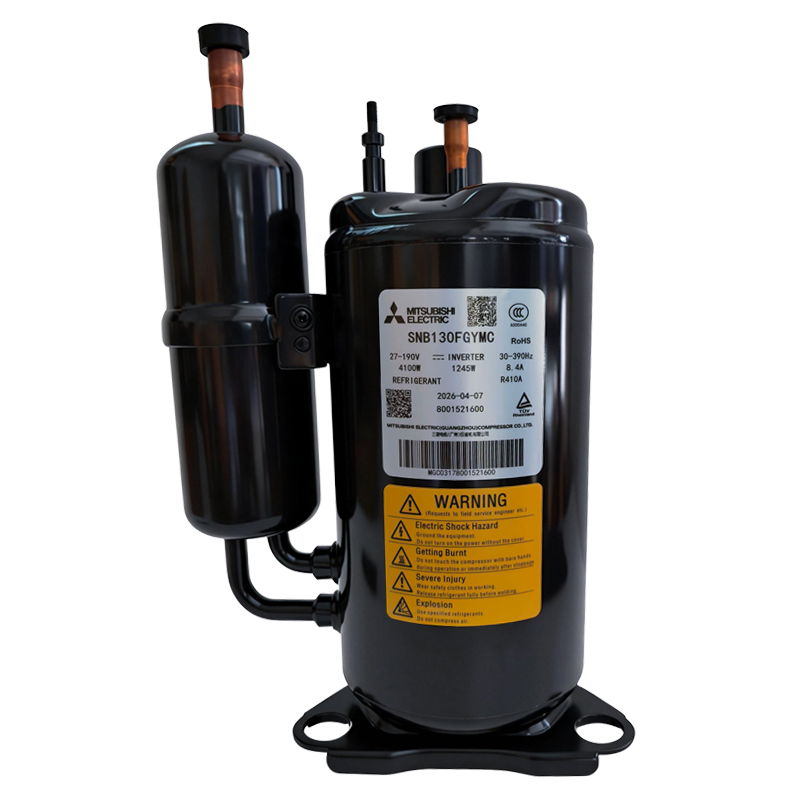
| SNB130FGYMC, R410A | 4,100 W | 13,989 | 13,940.0 | 13,989.8 | 3.412142 |
| TNB306FPGMC, R410A | 9,880 W | 33,711 | 33,592.0 | 33,712.0 | 3.412142 |
Two R32 pages use 3.4 and produce an exact match to the watt figure. Two R410A pages use 3.412142 and land within a single unit. The shortcut is not a site wide habit and it is not a rounding artefact; it is confined to the R32 block.
There is a direction to this that a buyer should notice. The short factor understates the British thermal unit figure by 0.36 per cent every time it is used. On these pages the error runs against the seller, not for him, which is the opposite of the usual direction of a data error in a listing. It is a small error, but it is a diagnostic one: it says the R32 block was filled from a different working file than the R410A block, and that is worth knowing when two blocks are compared.
A second storefront publishes a third set of numbers
The same seller maintains a second storefront, and the listing there describes this identical string with different figures.
| Field | Main storefront | Second storefront | Difference |
|---|---|---|---|
| Model string | TVB306FHTMC | TVB306FHTMC | same |
| Displacement | 30.6 cm3/rev | 30.6 cm3/rev | same |
| Refrigerant | R32 | R32 | same |
| Capacity | 10,270 W | 10,130 W | 140 W lower, 1.4 per cent |
| Power input | 3,290 W | 3,360 W | 70 W higher, 2.1 per cent |
| Coefficient of performance | 3.12 | 3.01 | 0.11 lower, 3.5 per cent |
| Capacity in British thermal units | 34,918 BTU/h | 3442 BTU |
a lost digit |
Both storefronts close internally. 10,130 divided by 3,360 is 3.0149, which rounds to the printed 3.01, so the second listing is not a careless transcription of the first; it is a different pair of numbers with its own consistent ratio.
The British thermal unit row on the second storefront is where the trail shows. 10,130 multiplied by 3.4 is 34,442. The listing prints 3442 BTU, which is that figure with its leading digit dropped. So the second storefront uses the same 3.4 shortcut and then loses a digit on top of it. A capacity of 3,442 British thermal units per hour would be about one kilowatt, which no 30.6 cm3/rev twin rotary compressor produces, so the row is not a smaller machine. It is a truncated string.
The practical consequence is blunt. A buyer who compares the two storefronts sees a 1.4 per cent capacity difference and a 3.5 per cent coefficient difference on the same part number, from the same seller, on the same day. Neither page carries a test condition that would explain it.
What the string decodes to, and the position the key does not cover
The catalogue's naming key prints a worked example and defines several positions. Applied to this string:
| Position | Key example | TVB306FHTMC | What the key says | Verdict |
|---|---|---|---|---|
| 1 | S | T | series letter | series letter, no alphabet given |
| 2 | N | V | refrigerant type | R32 according to the seller, but the key lists no V family |
| 3 | B | B | special series | B = BLDC-Cooling |
| 4 | 130 | 306 | stroke volume | 30.6 cm3/rev |
| 5 | F | F | F = Inverter | inverter driven |
| 6 | G | H | power supply code group | a supply code, unnamed for H |
| 7 | B | T | not defined for this position | undecoded |
| 8 | M | M | no definition in the key | undecoded |
| 9 | T | C | no definition in the key | undecoded |
The refrigerant position is the one that needs care here, and it needs care for a reason that is specific to this string. The key defines position two as the refrigerant field, and it documents families whose second letter is B, for R134a, and N, for R410A. It documents no family whose second letter is V. So the letter is defined as a field without this value appearing in the list of values, and the R32 assignment rests on the seller's own pages rather than on a manufacturer key.
That is not an accusation; it is a statement about the record. R32 appears on both storefronts, in the page title and in the specification block, consistently. What is absent is a third party saying it.
The displacement rule is verified independently of the letter. A three digit field in this family divides by ten, and this string's field is 306, which reads 30.6. The shop prints 30.6 cm3/rev and the second storefront prints 30.6 cm3/rev, and the R410A sibling at the same displacement prints the same value. Three agreements on a mechanical rule that has been checked across six codes in this family elsewhere.
Is there a manufacturer row for this string?
No document in reach prints a TVB row. That is a strong statement, so the basis for it is set out in full.
The document that would carry such a row is the Mitsubishi Electric rotary compressor catalogue, and the block it prints is set out below.
The catalogue this article series relies on prints an inverter twin rotary block in five families: CBB, SBB and TBB under the R134a heading, and SNB and TNB under the R410A heading. None of those five families carries V in the second position, and no row in that block begins with TVB. Searches for this string return the seller's own two storefronts and third party supplier lists, not a manufacturer document.
Two limits belong with that statement. The catalogue was not re-downloaded for this article, because the mirror that hosts it closes a direct connection without responding; the block's contents are known from a previous complete retrieval of the same address. And a document not in reach is not a document that does not exist. What can be said is that a buyer who asks a supplier for the manufacturer's printed row on this string, and receives one, will have obtained something this article could not.
The difference in kind matters for how the figures are used. On the R410A families, a shop block can be set against a manufacturer row and the two can be reconciled or not. On this string there is nothing to set it against, so the three sets of figures in the sections above are three seller statements, and the only tests available are internal ones.
The same swept volume in two refrigerants
The shop sells both refrigerants at 30.6 cm3/rev, which makes a comparison possible that is usually blocked by a displacement change.
| Page | Refrigerant | Displacement | Capacity | Input | Coefficient | Watts per cubic centimetre |
|---|---|---|---|---|---|---|
| TVB306FHTMC | R32 | 30.6 | 10,270 W | 3,290 W | 3.12 | 335.6 |
| TNB306FPGMC | R410A | 30.6 | 9,880 W | 3,010 W | 3.28 | 322.9 |
Equal displacement, 390 W more capacity on the R32 page, which is 3.9 per cent, and a coefficient 0.16 lower. The per cubic centimetre column shows the same 3.9 per cent, because the displacement did not change.
A volumetric difference at identical swept volume is what a refrigerant change produces, and that is the conventional reading of a figure pair like this: the same hardware moves a different amount of heat per revolution because the working fluid carries differently. This article states that as an interpretation and not as a measured property, because neither page prints the quantity that would test it, and the safety group and volumetric capacity of the two fluids are not printed anywhere on either page.
What the pair does establish is a design point. A buyer sizing a system at 30.6 cm3/rev has two published options at the same displacement and a 3.9 per cent capacity difference between them, with the R32 option carrying the lower coefficient. That is a real choice with a real trade off, and it can be made from published figures as long as the buyer knows the figures are seller published.
The manufacturer publishes this product line at its air conditioning and refrigeration compressor portal, and its European arm sets out the scroll and rotary piston range on a separate page. Every page in this family is filed under the Mitubishi Rotary Compressor category, and the wider rotary compressor category holds the other rotary families beside it. A reader moving from a twin rotary to a scroll machine for a colder or larger duty should read the Mitsubishi scroll range separately, because neither the swept volumes nor the test benches carry across.
Three pages, one block, and a page that names a different string
The shop has three pages in the 30.6 class. Two of them are the same string with and without a suffix. The third is where the census stops being tidy.
| Page address | Model row on that page | Block |
|---|---|---|
| r32-mitsubishi-inverter-compressor-tvb306fhtmc.html | TVB306FHTMC | 30.6, 3290 W, 10270 W, 34918 BTU/h, COP 3.12 |
| mitsubishi-inverter-compressor-tvb306fhtmc-s.html | TVB306FHTMC-S | identical |
| r32-mitsubishi-inverter-compressor-tvb306fpnmc.html | TVB306FHTMC | identical |
The third page's own address and page title say FPNMC, and its specification block says FHTMC. One of the two is wrong, and nothing on the page says which. The block is also byte for byte the same as the other two, including the British thermal unit figure that carries the 3.4 shortcut, so the third page did not measure anything; it inherited a template and kept another string's model row.
This is worth stating plainly because of what it does to the evidence. A count of three pages agreeing looks like three confirmations and is one template. The correct reading is that the shop has one published block for the 30.6 class, printed on three pages, one of which mislabels itself.
What no page prints
Five numbers an installer needs are absent from all three pages, and one of them is absent for a reason that is specific to this refrigerant.
| Missing | Why it matters |
|---|---|
| Test condition | without it the 10,270 W cannot be compared with any other published figure, including the seller's own second storefront |
| Rated speed range | it fixes the drive envelope and the usable turndown |
| Mass | it fixes the mounting frame |
| Oil charge | it fixes the commissioning sheet |
| Refrigerant safety group | it fixes which requirements apply to the assembled system |
The last row deserves its own sentence, because it is not a general complaint about thin listings. The current edition of IEC 60335-2-40 states in its own scope that it does not take into account refrigerants other than group A1, A2L, A2 and A3 as defined by ISO 817, and that flammable refrigerants are limited to those above a molar mass threshold it sets out. An R32 system therefore sits inside a scheme of requirements that depends on a group letter, and no page in this family prints that letter.
Three tests a buyer can run without a manufacturer row
When there is no manufacturer row to check a block against, three internal tests remain, and all three can be run on published figures in a few minutes.
The first is coefficient closure: divide capacity by input and see whether the printed ratio follows. The second is the conversion factor: multiply the watt figure by 3.412142 and see whether the British thermal unit row follows, or whether a short factor was used. The third is the per cubic centimetre band, which strips out the displacement and shows whether a set of pages was produced consistently.
The fourth row of the table below is the reason the third test is worth running. The seller's two refrigerants do not overlap in that band, which is what a real physical difference looks like, and the seller's two R32 pages sit within one per cent of each other, which is what a consistent template looks like.
| Page | Refrigerant | Displacement | Capacity | Watts per cubic centimetre |
|---|---|---|---|---|
| TVB306FHTMC | R32 | 30.6 | 10,270 W | 335.6 |
| TVB220FAEMC | R32 | 22.0 | 7,310 W | 332.3 |
| TNB306FPGMC | R410A | 30.6 | 9,880 W | 322.9 |
| SNB130FGYMC | R410A | 13.0 | 4,100 W | 315.4 |
Two bands, 332.3 to 335.6 for R32 and 315.4 to 322.9 for R410A, with a wider gap between them than within either. The spread inside the R32 pair is 1.0 per cent even though the larger machine displaces 39 per cent more gas, which is the signature of one design scaled rather than two unrelated entries.
All three tests pass here. The coefficient closes at 3.12, the conversion defect is identified and quantified rather than unexplained, and the per cubic centimetre values form two coherent bands. That is the honest summary of this block: its arithmetic is sound, its internal consistency is good, and its weakness is provenance rather than computation. A buyer who needs more than that needs a document the seller has not published.
What to specify before ordering
| Question | Why it decides something |
|---|---|
| Which storefront's figure will the invoice follow, 10,270 W or 10,130 W? | the same seller publishes both, 1.4 per cent apart, on one part number |
| What condition is the capacity rated at? | no page prints one, so the figure cannot be compared with a competitor's |
| Which figure is the British thermal unit row meant to be? | one storefront prints 34,918 and the other prints a four digit truncation of 34,442 |
| What is the refrigerant safety group, and against which edition of IEC 60335-2-40 is the system assessed? | the standard's scope turns on the ISO 817 group letter and the shop prints none |
| Is the machine the component certified under IEC 60335-2-34? | that part covers sealed motor-compressors and their protection and control systems |
| What are the mass, the oil charge and the rated speed range? | the three numbers that a frame, a commissioning sheet and a drive setting are built from |
| Is there a manufacturer row for this string at all? | if a supplier can produce one, it settles more than any of the questions above |
Two standards answer most of the list, and both are published with scopes a buyer can read. IEC 60335-2-34 covers the sealed motor-compressor as a component, including its protection and control systems. IEC 60335-2-40 covers the assembled heat pump or air conditioner and frames its refrigerant requirements by ISO 817 group. Rating practice for capacity claims in North America is set out by AHRI, and refrigerant global warming potential values used in policy comparisons are tabulated by the German Environment Agency.
For the demand side, the International Energy Agency's report on the future of cooling sets out the growth curve air conditioning is on. It is background rather than evidence about this machine, and it is cited as background.
What this article rests on
| Source | What it is | Use in this article |
|---|---|---|
| Shop page TVB306FHTMC | seller listing | the block reproduced in full, and the 3.4 conversion |
| Shop page TVB306FHTMC-S | seller listing | the identical block, and the suffix variant |
| Shop page TVB306FPNMC | seller listing | the mislabelled model row |
| Shop page TVB220FAEMC | seller listing | the second 3.4 conversion at 22.0 cm3/rev |
| Shop page SNB130FGYMC | seller listing | the R410A comparison at 13.0 cm3/rev |
| Shop page TNB306FPGMC | seller listing | the R410A comparison at 30.6 cm3/rev |
| Second storefront listing for TVB306FHTMC | seller listing on another platform | the third set of figures and the truncated British thermal unit row |
| Shop sitemap, 6149 addresses | site inventory | the four TVB addresses and the shape of the family |
| Manufacturer rotary compressor catalogue | manufacturer document, third party mirror | the naming key, its example, and the five families it documents |
| IEC 60335-2-34:2024 | standards body | the component scope for sealed motor-compressors |
| IEC 60335-2-40:2024 | standards body | the system scope, and the ISO 817 group limit |
| AHRI standards and the Federal Environment Agency table | certification body, regulator reference | rating practice and global warming potential values |
| International Energy Agency, the future of cooling | research report | market direction |
Frequently asked questions
Is TVB306FHTMC a real Mitsubishi model?
It is a real part number in the sense that it is sold under that name, with a specification block, on two storefronts belonging to one seller. No manufacturer document in reach prints a TVB row, and no independent listing this article could open carries the string. Its status as a catalogue model is therefore unconfirmed, and this article does not claim otherwise.
What refrigerant does it use?
R32, according to both of the seller's storefronts, consistently and in the specification block as well as the title. The R in the second position of the naming key is the refrigerant field, but the key documents no family with V in that position, so the assignment rests on the seller rather than on a manufacturer key. It is not contradicted by anything in reach.
What is the swept volume?
30.6 cm3/rev. The three digit field 306 divides by ten in this family, and the rule has been checked on six displacement points across the SNB and TNB blocks. Both storefronts print 30.6, and the R410A sibling at the same displacement prints the same value.
What capacity and input does it print?
10,270 W at 3,290 W input, a coefficient of 3.12, on the main storefront. 10,130 W at 3,360 W input, a coefficient of 3.01, on the second storefront. Both pairs close arithmetically. The difference is 1.4 per cent on capacity, 2.1 per cent on input and 3.5 per cent on the coefficient.
Why do the British thermal unit figures look wrong?
Because they are computed with 3.4 instead of 3.412142. 10,270 times 3.4 is exactly the printed 34,918, while the standard factor gives 35,042.7. On the second storefront the same shortcut is applied to 10,130, giving 34,442, and the listing then prints four digits instead of five. The shortcut understates by 0.36 per cent each time.
Is the 3.4 factor used everywhere on this site?
No. It appears on the two R32 pages checked and on neither of the two R410A pages checked, which use 3.412142 and land within one unit of the standard conversion. The shortcut is confined to the R32 block, which suggests the two blocks were filled from different working files.
Is the shop's block reliable?
It is internally consistent, it is reproduced identically on three pages, and its arithmetic closes. It is also the only published source for these figures, and one of the three pages prints another string in its own model row. Reliability here is not a question of arithmetic; it is a question of there being nothing independent to check it against.
How does it compare with the R410A compressor at the same displacement?
At 30.6 cm3/rev the R32 page prints 10,270 W against the R410A page's 9,880 W, which is 3.9 per cent more capacity, at a coefficient of 3.12 against 3.28. Equal swept volume means the difference is about the working fluid, and that is an interpretation rather than a measured property, because neither page carries what would test it.
What should I ask for before ordering?
Which storefront's figures the invoice follows, the test condition behind the capacity, the refrigerant safety group and the edition of IEC 60335-2-40 the system is assessed against, the mass, the oil charge, the rated speed range, and a manufacturer row for the string if one exists. Each of those is a gap identified above, and each answer is a document rather than a claim. The full product index lists what else is stocked across the family, and the newer write-ups on this site apply the same arithmetic audit to neighbouring displacements, including a Mitsubishi Rotary Compressor SNB200FNMMC study on the 20.0 class.
Mitsubishi SNB130FGYMC Rotary compressor
Related Article