
Mitsubishi SNB130FGYMC Rotary compressor
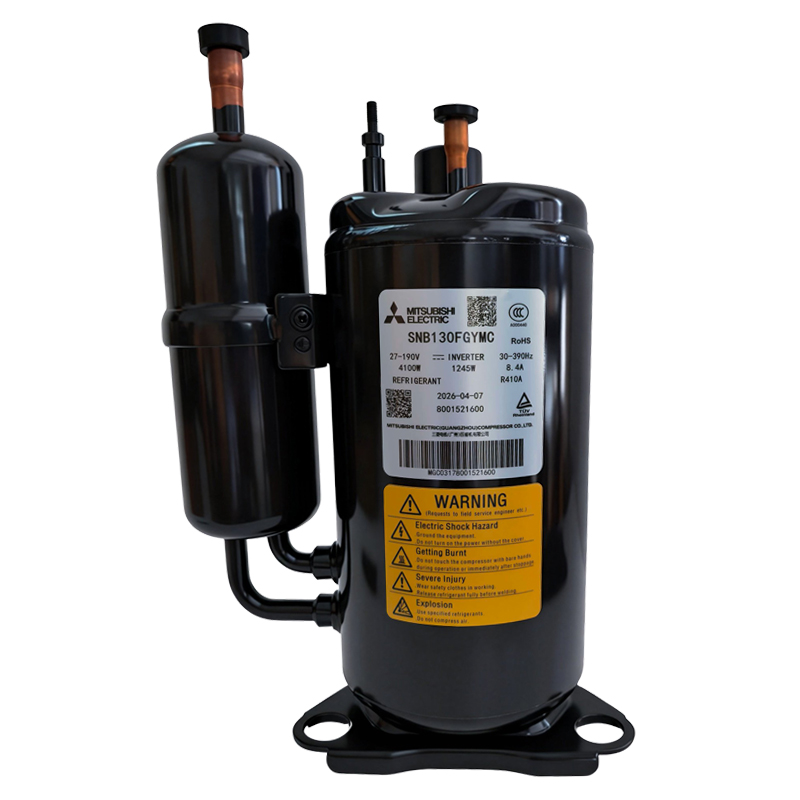
Mitsubishi SNB130FGYMC R410A Inverter Rotary Compressor: The 13.0 Class, and a Four Per Cent Gap That Runs the Wrong Way
The reference row, and the arithmetic that holds it together
The 13.0 row prints four figures that can be checked against each other without leaving the page.
| Field | Printed value | Note |
|---|---|---|
| Swept volume | 13.0 cm3/rev | the row's displacement, and the class this article is about |
| Rated cooling capacity | 3,912 W | the figure a system designer sizes from |
| Rated power input | 1,254 W | the figure an electricity bill is computed from |
| Coefficient of performance | 3.12 | printed as a ratio, and recomputable from the two figures above |
3,912 divided by 1,254 is 3.1196, which rounds to the printed 3.12. The row closes on its own terms. That matters more than it sounds, because a printed ratio column is often copied rather than computed, and a copied ratio can drift away from the two figures it is supposed to describe. Here it has not drifted.
The same check runs clean across the three other rows the family prints, so the closure is a property of the block and not of this one row. The arithmetic audit later in this article sets out all of them, including the one row in the catalogue that does not close.
What the string decodes to, and the two letters that separate it
The catalogue's naming key prints a worked example, S N B 130 F G B M T, and defines some of its positions. Applying it to the string this article is about gives the following.
| Position | Key example | SNB130FGYMC | What the key says | Verdict |
|---|---|---|---|---|
| 1 | S | S | series letter | series letter, no definition in the key |
| 2 | N | N | refrigerant type | R410A, confirmed twice over |
| 3 | B | B | special series | B = BLDC-Cooling |
| 4 | 130 | 130 | stroke volume | 13.0 cm3/rev |
| 5 | F | F | F = Inverter | inverter driven |
| 6 | G | G | power supply | supply code group, G = 220 to 240 V at 50 Hz or 230 V at 60 Hz |
| 7 | B | Y | not defined for this position | the first letter that separates the strings |
| 8 | M | M | no definition in the key | undecoded |
| 9 | T | C | no definition in the key | the second letter that separates the strings |
Two independent statements fix the refrigerant, which is why the N is not a guess. The key lists N inside its power supply group as well, so a single occurrence proves nothing. What settles it is the catalogue's own grouping: three families whose second letter is B are filed under R134a Inverter, and two families whose second letter is N are filed under R410A Inverter. One document cannot say both things by accident. The N is R410A.
The displacement rule is the one position that carries a performance consequence, and it is worth stating in the direction it actually runs. A three digit field in this family divides by ten. Eight SNB codes confirm it: 092 reads 9.2, 110 reads 11.0, 130 reads 13.0, 140 reads 14.0, 150 reads 15.0, 172 reads 17.2, 200 reads 20.0 and 220 reads 22.0. The rule does not generalise to every Mitsubishi rotary family. In the two digit MNB classes the digits sit at the displacement itself, and applying the divide by ten rule there produces a figure an order of magnitude out. The direction of the rule is family specific, and getting it wrong is the most common way a catalogue figure is misread.
The manufacturer publishes this line at its air conditioning and refrigeration compressor portal, and its European arm sets out the scroll and rotary piston range on a separate page.
Position seven is where the two strings part company for the first time, and the key is silent about it. The example itself carries B there, which is the same letter the 13.0 catalogue row carries, but the key does not say what B means in that position, and it does not list Y at all. Position nine is where they part company for the second time, and the key is silent about that too. So the honest count is this: five positions are decodable, two are demonstrably the same in both strings, and two are different with no document defining either.
What this shop publishes for the 13.0 class
The shop's page for SNB130FGYMC carries a specification block with nine rows, and it is reproduced below without editing.
| Field | Value as printed |
|---|---|
| Model | SNB130FGYMC |
| Displacement | 13cm3/rev |
| Input | 1200W |
| Capacity | 4100W |
| Capacity, British thermal units | 13989BTU/h |
| Refrigerant | R410A |
| Voltage | INVERTER Compressor |
| COP | 3.42W/W |
| Dimension | 230.1A/mm |
| Usage/Application | AC,drier,refrigeration,chiller,etc. |
This block closes arithmetically, and it closes in both identities. 4,100 divided by 1,200 is 3.4167, which rounds to the printed 3.42. 4,100 multiplied by 3.412142 is 13,989.8, against a printed 13,989, a residual of 0.8 British thermal units per hour, which is rounding and nothing else. The conversion factor is the standard one; the non standard 3.4 factor recorded elsewhere in this trade does not appear here.
The block is also not unique to this page. Three other pages in the same class carry the identical nine rows, character for character, including the displacement, the capacity, the input and the coefficient. That is a template effect, not four independent measurements, and it means the block can never be used to distinguish one of those strings from another.
| Page | String | Block |
|---|---|---|
| SNB130FGYMC | this article's string | 13cm3/rev, 1200W, 4100W, COP 3.42 |
| SNB130FGAMC | the A-code variant | identical |
| SNB130FGCMC-S | the C-code variant with a suffix | identical |
| SNB130FGYMC-L1 | the -L1 suffix variant | identical |
Four rows of that block are worth naming because of what they do not say. There is no rated speed, no mass, no oil charge and no test condition. Those are the four numbers an installer needs: speed range fixes the drive's operating envelope, mass fixes the mounting frame, oil charge fixes the commissioning sheet, and the condition fixes whether the capacity figure can be compared with anything else on the market. A block with a capacity and no condition is a number without a frame of reference.
Every page in this family is filed under the Mitubishi Rotary Compressor category, which is where a buyer holding only a part number should start, and the wider rotary compressor category holds the other rotary families beside it.
The shop block against the catalogue row, field by field
Setting the two documents side by side at the same displacement produces the following.
| Field | Manufacturer row, SNB130FGBMT | Shop block, SNB130FGYMC | Difference |
|---|---|---|---|
| Swept volume | 13.0 cm3/rev | 13 cm3/rev | same |
| Rated cooling capacity | 3,912 W | 4,100 W | 188 W higher, 4.8 per cent |
| Rated power input | 1,254 W | 1,200 W | 54 W lower, 4.3 per cent |
| Coefficient of performance | 3.12 | 3.42 | 0.30 higher, 9.6 per cent |
| Refrigerant | R410A | R410A | same |
| Test condition | ASHRAE, printed for the block | not printed | absent from the shop |
The direction of both differences is the same, and it is the direction that flatters the product. Capacity is higher, input is lower, and the ratio of the two is higher by roughly twice either individual change. A buyer who quoted the shop block and received a machine that behaved like the catalogue row would find 4.8 per cent less capacity and 4.3 per cent more input than promised, and the coefficient would be 9.6 per cent adrift.
None of that establishes that the shop block is wrong. It establishes that the two documents disagree, in a specific direction, by specific amounts. Whether the disagreement is an error, a different machine, or a different measurement is the next question, and it has to be asked before the numbers are used.
Is one page wrong, or is the whole family offset?
A single page that disagrees with a single catalogue row could be a typo. A whole family that disagrees in the same direction is a pattern, and the pattern is what makes this article worth writing.
Three displacements appear in both documents, so three pairs can be set against each other.
| Displacement | Catalogue capacity and input | Shop capacity and input | Capacity change | Input change | Coefficient change |
|---|---|---|---|---|---|
| 11.0 cm3/rev | 3,294 W and 1,033 W | 3,400 W and 1,000 W | 106 W higher, 3.2 per cent | 33 W lower, 3.2 per cent | 3.19 to 3.40, 6.6 per cent higher |
| 13.0 cm3/rev | 3,912 W and 1,254 W | 4,100 W and 1,200 W | 188 W higher, 4.8 per cent | 54 W lower, 4.3 per cent | 3.12 to 3.42, 9.6 per cent higher |
| 17.2 cm3/rev | 5,237 W and 1,636 W | 5,400 W and 1,612 W | 163 W higher, 3.1 per cent | 24 W lower, 1.5 per cent | 3.20 to 3.35, 4.7 per cent higher |
Three pairs, one direction. Capacity is higher on the shop side in all three, input is lower in all three, and the coefficient is higher in all three. The magnitudes cluster rather than scatter: capacity gains of 3.1 to 4.8 per cent, input reductions of 1.5 to 4.3 per cent.
A uniform offset across independent rows is the signature of a systematic difference, not of a typographical one. A mistyped digit does not move three rows in the same direction by similar proportions. Something systematic is going on, and the candidates are a different machine, a different bench, or a different editorial policy for filling a template.
One further observation belongs here and is easy to miss, so it is set out as its own table.
| Page | Capacity | Input | Coefficient |
|---|---|---|---|
| SNB172FJFMC-S | 5,400 W | 1,580 W | 3.42 |
| SNB172FJGMC | 5,400 W | 1,612 W | 3.35 |
Two pages, one capacity, one refrigerant, two inputs, and therefore two coefficients 0.07 apart. So the shop's own block is not fully determined by the capacity alone. That does not create a contradiction, because the two pages may describe two builds. It does show that the shop's coefficient column is filled per page rather than derived once for the class.
Capacity per swept cubic centimetre: what it shows and what it cannot
Dividing capacity by swept volume strips out the displacement and leaves a figure that says how hard a compressor works for its size. It needs no condition sheet and no voltage, which is exactly why it is useful as a first pass over a family.
| Source | Displacement | Capacity | Watts per cubic centimetre |
|---|---|---|---|
| Catalogue, 9.2 row | 9.2 | 2,780 W | 302.2 |
| Catalogue, 11.0 row | 11.0 | 3,294 W | 299.5 |
| Catalogue, 13.0 row | 13.0 | 3,912 W | 300.9 |
| Catalogue, 17.2 row | 17.2 | 5,237 W | 304.5 |
| Shop, 11.0 page | 11.0 | 3,400 W | 309.1 |
| Shop, 13.0 page | 13.0 | 4,100 W | 315.4 |
| Shop, 14.0 page | 14.0 | 4,380 W | 312.9 |
| Shop, 15.0 page | 15.0 | 4,620 W | 308.0 |
| Shop, 17.2 page | 17.2 | 5,400 W | 314.0 |
| Shop, 20.0 page | 20.0 | 6,220 W | 311.0 |
| Shop, 22.0 page | 22.0 | 6,840 W | 310.9 |
The catalogue's four rows sit in a tight band, 299.5 to 304.5, a spread of 1.7 per cent across a displacement range of nearly a factor of two. That is what one scaled design looks like when it is measured consistently.
The shop's seven pages sit in a band of their own, 308.0 to 315.4. The two bands do not overlap. Seven pages against four, and not a single crossing.
This is the cleanest form the disagreement takes, and it is also the most limited. The test says the two sets were not produced the same way. It does not say which set is more accurate, because a different bench would shift the whole band just as a data error would, and the test cannot tell those apart. What it does say is that quoting one document and delivering the other is a 3 to 4 per cent surprise, and that the surprise is present at every displacement in the family rather than at one.
A reader comparing this class against a scroll machine for a colder or larger duty should read the Mitsubishi scroll range separately, because neither the swept volumes nor the benches carry across.
The arithmetic audit across both documents
Twelve rows of capacity, input and coefficient, taken from both documents, recomputed here.
| Row | Capacity | Input | Recomputed coefficient | Printed | Closes |
|---|---|---|---|---|---|
| Catalogue 9.2 | 2,780 W | 872 W | 3.1881 | 3.19 | yes |
| Catalogue 11.0 | 3,294 W | 1,033 W | 3.1888 | 3.19 | yes |
| Catalogue 13.0 | 3,912 W | 1,254 W | 3.1196 | 3.12 | yes |
| Catalogue 17.2 | 5,237 W | 1,636 W | 3.2011 | 3.20 | yes |
| Shop 11.0 | 3,400 W | 1,000 W | 3.4000 | 3.40 | yes |
| Shop 13.0 | 4,100 W | 1,200 W | 3.4167 | 3.42 | yes |
| Shop 14.0, one page | 4,380 W | 1,310 W | 3.3435 | 3.34 | yes |
| Shop 14.0, other page | 4,380 W | 1,300 W | 3.3692 | 3.37 | yes |
| Shop 15.0 | 4,620 W | 1,420 W | 3.2535 | 3.25 | yes |
| Shop 17.2, one page | 5,400 W | 1,580 W | 3.4177 | 3.42 | yes |
| Shop 17.2, other page | 5,400 W | 1,612 W | 3.3499 | 3.35 | yes |
| Shop 20.0 | 6,220 W | 1,840 W | 3.3804 | 3.38 | yes |
| Shop 22.0 | 6,840 W | 2,060 W | 3.3204 | 3.32 | yes |
Every row closes. The shop is not sloppy with its own arithmetic, and neither is the catalogue. Whatever separates the two documents, it is not a division error on either side, and that is worth saying plainly because it removes the easiest explanation and forces the harder one.
The wider catalogue does contain one row that fails this test, and it belongs in the record even though it does not touch this family. The SBB172F row prints 2,600 W capacity, 710 W input and a coefficient of 3.68. Recomputed, 2,600 divided by 710 is 3.6620, which rounds to 3.66 and not to 3.68. The gap is 0.018, about half a per cent. Working backwards from a coefficient of 3.68 and a capacity of 2,600 W gives an input of 706.5 W rather than the printed 710 W. This article does not assert which cell is wrong. It records that a printed ratio column should be recomputed before it is used as a decision input, and it notes that the two TNB rows and every SNB row audited here pass.
Displacement, checked against a third party
The one field where an independent check exists is swept volume, and it is worth using because it separates two of the three possible explanations for the disagreement.
A distributor's rotary compressor list prints SNB130FGYMC at 13.0 cm3/rev. It is not the manufacturer, it carries no capacity, and it is not a substitute for either document. But it is a third party that agrees with the shop on the one field both pages print, and it reached 13.0 by a route that has nothing to do with the shop's template.
So the displacement is settled: 13.0 cm3/rev, three ways. What that rules out is the cheapest explanation of all, that the shop and the catalogue are describing different sizes of machine. They are not. The disagreement sits inside the same displacement, on capacity and input, and that location is what makes it matter for a buyer who is comparing a claimed coefficient against a quoted one.
The condition nobody prints, and why it cannot explain the gap
Both figures in this family are measured at conditions, and the catalogue prints its conditions. Evaporating temperature 7.2 degrees Celsius, condensing temperature 54.4 degrees Celsius, superheat 27.8 kelvin and subcooling 8.3 kelvin under the heading ASHRAE conditions; the same evaporating and condensing temperatures with 11.1 kelvin of superheat and the same subcooling under the heading ARI conditions.
The shop prints no condition at all, on any page in the family. So the first question about any shop capacity figure is which bench it came from.
The catalogue's two benches are worth looking at closely, because they almost explain the gap and then fail to. The two differ in superheat by 16.7 kelvin and in nothing else: evaporating temperature, condensing temperature and subcooling are identical. At the same evaporating pressure, colder suction gas is denser gas. Denser gas through the same swept volume is more mass flow, which is more cooling capacity. But more mass at the same pressure ratio is also more work, so the power input moves up with the capacity rather than down.
The shop's figures move in the other combination. Capacity is 4.8 per cent higher, input is 4.3 per cent lower, and the coefficient between them is 9.6 per cent higher. A move from the ASHRAE bench to the ARI bench cannot produce that pair, because the two figures would rise together. So the bench difference, which is the most respectable explanation available, does not account for the observation.
That leaves two candidates. Either the shop's Y string is a genuinely different build from the catalogue's B string, in which case both documents can be right and the numbers simply do not transfer between them, or the shop block is optimistic. The published record does not contain the document that would decide between those two, and this article does not pretend otherwise. What it can do is tell a buyer exactly what to ask for, which is the next section.
What to specify before ordering
Every question below follows from a gap identified above, and none of them requires the buyer to take a side in an argument between two documents.
| Question | Why it decides something | Where the gap came from |
|---|---|---|
| Which string will you ship, SNB130FGYMC or SNB130FGBMT? | the two differ at positions seven and nine, and no document defines either position | the naming key is silent on both |
| What condition is the 4,100 W rated at? | the catalogue prints ASHRAE and ARI benches; the shop prints none | the shop block has no condition row |
| Is 4,100 W at 27.8 kelvin superheat or at 11.1 kelvin? | the same machine gives different figures on the two benches, and the input moves with the capacity | two benches are printed in the catalogue |
| What is the rated speed range? | it fixes the drive envelope and the usable turndown | absent from the shop block; the catalogue's block prints it for each row |
| What are the mass and the oil charge? | mounting frame and commissioning sheet | absent from the shop block |
| Which document's coefficient governs the warranty discussion? | a 9.6 per cent coefficient gap is the difference between two commercial positions | the two documents disagree at the same displacement |
Two standards govern the answers in most markets. IEC 60335-2-34 covers the compressor as a component, and IEC 60335-2-40 covers the assembled system and its refrigerant charge; a supplier who cannot say which one the machine is certified against has not finished the paperwork. Rating practice for capacity claims is set out by AHRI, and refrigerant global warming potential values that feed any efficiency or policy comparison are tabulated by the German Environment Agency.
For context on why the efficiency column gets so much attention in this trade, the International Energy Agency's report on the future of cooling sets out the demand curve that air conditioning is on. It is background, not evidence about this machine, and it is cited as background.
What this article rests on
Every figure above comes from one of the documents in the table below, and the table says which fact each one carries. Nothing is quoted from a source that was not opened.
| Source | What it is | Use in this article |
|---|---|---|
| Mitsubishi Electric rotary compressor catalogue | manufacturer document, third party mirror | the 13.0 row, the naming key and example, the refrigerant grouping, both benches, the three other SNB rows, the SBB172F row |
| Mitsubishi Electric compressor portal | manufacturer product site | where the product line is published |
| Mitsubishi Electric European compressor page | manufacturer site | the scroll and rotary piston range page |
| Shop page SNB130FGYMC | shop listing | the specification block reproduced in full |
| Shop pages SNB130FGAMC, SNB130FGCMC-S, SNB130FGYMC-L1 | shop listings | the shared-block finding |
| Shop pages SNB172FJFMC-S and SNB172FJGMC | shop listings | the two-inputs-one-capacity finding |
| Shop pages at 11.0, 14.0, 15.0, 20.0 and 22.0 | shop listings | the seven-page capacity per cubic centimetre set |
| Shop sitemap, 6148 addresses | site inventory | the family inventory and the absence of a T-ending page |
| Direct requests for the T-ending form | own measurement | 404 |
| Distributor rotary compressor list | trade listing | the independent 13.0 displacement reading |
| IEC 60335-2-34 and IEC 60335-2-40 | standards body | component and system safety scope |
| AHRI standards and the Federal Environment Agency table | certification body, regulator reference | rating practice, refrigerant global warming potential |
| International Energy Agency, the future of cooling | research report | market direction |
Frequently asked questions
Is SNB130FGYMC a real Mitsubishi model?
The string is real in the sense that it is sold, specified and shipped by this shop under that name, and a distributor lists it at 13.0 cm3/rev. It is not the string the manufacturer catalogue prints for the 13.0 cm3/rev row of this family, which is SNB130FGBMT. The two differ at position seven, where the catalogue has B and the shop has Y, and at position nine, where the catalogue has T and the shop has C. No document in reach defines either position.
Does the shop have a page for the catalogue string?
No. A request for the T-ending form returns 404, and the site's sitemap, which lists 6,148 addresses, contains no address for it. The shop sells the C-ending form, and the page for it carries the specification block reproduced above.
What refrigerant does SNB130FGYMC use?
R410A. Three independent statements agree: the catalogue's refrigerant grouping puts every N-family row under R410A Inverter, the catalogue's 13.0 row is in that block, and the shop's own block prints R410A. The N in the second position is the refrigerant code, and it is confirmed by the grouping rather than by the key alone, because the key uses the same letter inside its power supply group.
What is the swept volume?
13.0 cm3/rev. The three digit field 130 divides by ten in this family, and eight SNB codes confirm the rule. A distributor independently prints 13.0 for this string. The same rule does not apply to the two digit MNB classes, where the digits already are the displacement.
What capacity and input does each document print?
The manufacturer row prints 3,912 W at 1,254 W input, a coefficient of 3.12, at ASHRAE conditions. The shop block prints 4,100 W at 1,200 W input, a coefficient of 3.42, with no condition stated. Both close arithmetically. The difference is 4.8 per cent more capacity for 4.3 per cent less input.
Why does the difference matter if both documents are internally consistent?
Because the two figures are quoted in the same commercial conversation. A buyer comparing a claimed coefficient against a quoted one is comparing 3.12 with 3.42, and internal consistency does not tell him which of the two his machine will resemble. The gap is 9.6 per cent on the coefficient, which is larger than most of the efficiency improvements a buyer is asked to pay for.
Is the shop's block unreliable?
Not on the evidence available. It closes arithmetically, it matches the catalogue on displacement and refrigerant, and its conversion to British thermal units uses the standard factor rather than the non standard one recorded elsewhere in this trade. What is unreliable is treating it as interchangeable with the catalogue row. The same shop does reproduce other manufacturer rows exactly, so the block is not uniformly shifted.
Could the difference be a test bench?
The catalogue prints two benches, differing by 16.7 kelvin of superheat and in nothing else. Moving to the warmer suction bench raises capacity and raises the power input with it, because the same swept volume passes more mass at the same pressure ratio. The shop's figures show capacity up and input down, which is the other combination. So a bench change alone does not explain the pair, though it remains a plausible contributor to the capacity figure on its own.
What should I ask for before ordering?
The shipping string in writing, the test condition behind the rated capacity, the rated speed range, the mass, the oil charge and the standard the machine is certified against. Each of those is a gap identified in the sections above, and each answer can be checked against a document rather than accepted on trust. The full product index lists what else is stocked across the family, and the newer write-ups on this site cover neighbouring displacements, including a Mitsubishi Rotary Compressor SNB200FNMMC study that applies the same arithmetic audit to the 20.0 class.
Mitsubishi TVB306FHTMC air conditioner compressor
Mitsubishi MNB33FBDMC-L AC Refrigeration Compressors
Related Article


