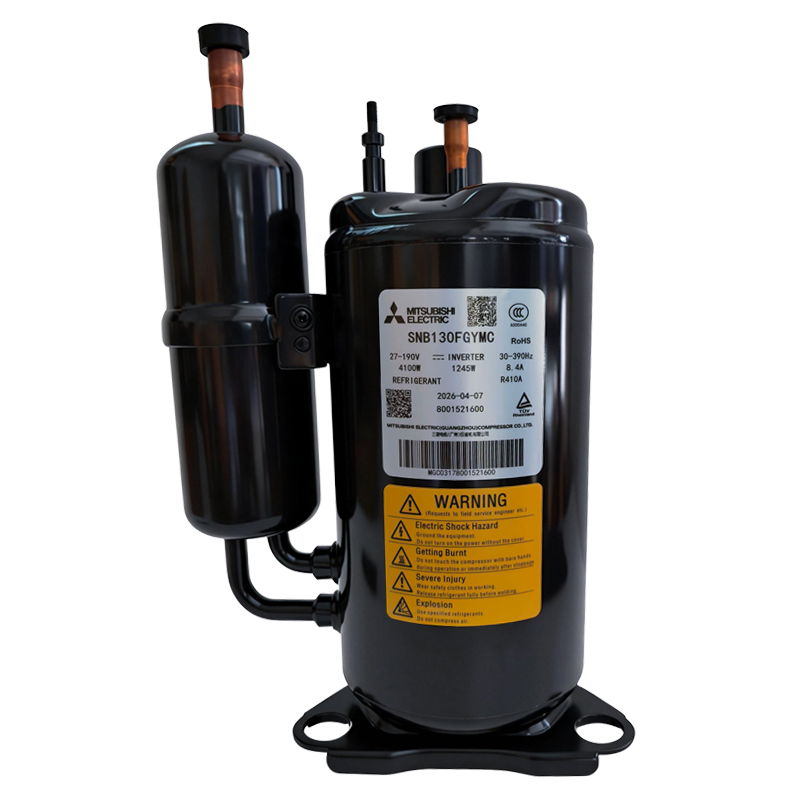
Mitsubishi Rotary compressor TNB306FPGMT

Mitsubishi TNB306FPGMT R410A Inverter Rotary Compressor: A Full Catalogue Row, and a Shop String That Sits One Character Away
Is TNB306FPGMT in the manufacturer catalogue?
Yes. It is a printed row in the Mitsubishi Electric rotary compressor catalogue, in the twin rotary inverter block, under the R410A heading. It is not a derived string assembled from a code table, and it is not a class approximation. The row sits beside TNB306FPNMT, which carries an identical capacity, input, coefficient, mass and oil charge and differs only in its current column.
The cube that follows is the whole of what that document says about this model, together with the same field from the row beside it, so that the reader can see which fields are shared and which are not.
| Field | TNB306FPGMT | TNB306FPNMT |
|---|---|---|
| Swept volume | 30.6 cm3/rev | 30.6 cm3/rev |
| Rated cooling capacity | 9880W | 9880W |
| Rated power input | 3010W | 3010W |
| Coefficient of performance | 3.28 | 3.28 |
| Current | 13.5 A | 9.3 A |
| Mass | 16.0 kg | 16.0 kg |
| Oil charge | 870 cm3 | 870 cm3 |
| Speed range | 15 to 120 rps | 15 to 120 rps |
| Refrigerant | R410A | R410A |
Seven of the nine fields are identical across the two rows. Two strings that share seven fields including capacity, input and swept volume are one machine with one electrical difference, and the catalogue does not say what that difference is. Section 7 deals with it and declines to explain it.
The condition the row is rated at
A capacity in watts is not a specification until the bench is named. The catalogue prints two bench definitions and they are not interchangeable.
| Bench | Evaporating | Condensing | Superheat | Subcooling | Where it is printed |
|---|---|---|---|---|---|
| ASHRAE conditions | 7.2 C | 54.4 C | 27.8 K | 8.3 K | the note that follows the twin rotary family tables |
| ARI conditions | 7.2 C | 54.4 C | 11.1 K | 8.3 K | the compressor product line spread |
The two definitions agree on evaporating, condensing and subcooling and differ only in superheat, 27.8 K against 11.1 K. Twenty-seven kelvin of superheat is a severe bench: it means the gas entering the compressor is far warmer than the evaporating temperature implies, which lowers mass flow for the same swept volume and lowers the measured capacity. It is also the bench that the note following the TNB tables names.
This matters commercially more than any other single line in the article. Two suppliers can quote 30.6 cm3/rev machines and differ by fifteen or twenty per cent in capacity, both accurately, because one quoted the ASHRAE bench and one quoted the ARI bench. The shop pages in this article print no condition at all, so a figure lifted from them cannot be placed beside a figure lifted from a catalogue without asking which bench the catalogue figure came from.
What the string decodes to, and four positions that do not
The catalogue prints a naming key with a worked example, S N B 130 F G B M T. Aligning TNB306FPGMT against that example produces a mixed result: five positions can be established and four cannot.
| Position | Example | TNB306FPGMT | What the key says | Verdict |
|---|---|---|---|---|
| 1 | S | T | series letter, no letters given | series, determined from the catalogue's family list |
| 2 | N | N | refrigerant type | R410A, confirmed twice below |
| 3 | B | B | special series | BLDC-Cooling |
| 4 | 130 | 306 | swept volume | 30.6 cm3/rev |
| 5 | F | F | motor type | Inverter |
| 6 | G | P | power supply in the example | no code group contains P, not decoded |
| 7 | B | G | refrigerant in the example | G is a documented supply code, position not resolved |
| 8 | M | M | no definition in the key | not decoded |
| 9 | T | T | no definition in the key | not decoded |
The refrigerant letter is worth proving rather than asserting, because N appears in two different code groups and one of them is a supply code. The proof comes from the catalogue's own page grouping rather than from the key.
| Catalogue group | Families on that page | Second character |
|---|---|---|
| R134a Inverter | CBB, SBB, TBB | B |
| R410A Inverter | SNB, TNB | N |
Five twin rotary families, two refrigerant headings, and the second character splits exactly along the heading. The same catalogue places TBB under R134a and TNB under R410A, so B cannot mean R410A and N cannot mean R134a. That is a cross-check between two independent statements in one document, not a positional guess.
The special series letter holds for the same reason: all five families carry B in the third position, and the key defines B as BLDC-Cooling, which matches the block heading the rows are printed under, twin rotary inverter BLDC.
The swept volume field is the one that carries a performance consequence, and it is verified on six codes rather than one.
| Model string | Three digit field | Field divided by ten | Printed swept volume |
|---|---|---|---|
| TNB306FPGMT | 306 | 30.6 | 30.6 cm3/rev |
| TNB306FPNMT | 306 | 30.6 | 30.6 cm3/rev |
| TNB306FPPMC | 306 | 30.6 | 30.6 cm3/rev |
| TNB220FLHMT | 220 | 22.0 | 22.0 cm3/rev |
| TNB220FLHMC | 220 | 22.0 | 22 cm3/rev |
| SNB200FGMMC | 200 | 20.0 | 20 cm3/rev |
Six codes, six passes, and the two families' published swept volumes are inside the test set. Note the direction of the rule: a three-digit field in the TNB and SNB families divides by ten. That is the opposite of the two-digit MNB classes, where the digits sit at the swept volume itself, and applying the wrong rule to the wrong family produces a figure an order of magnitude out.
Why the last character matters more than the others
The ninth position is the one a buyer meets first, because it is the character that changes between the catalogue and the shop.
| Source | String | Final character |
|---|---|---|
| Manufacturer catalogue | TNB306FPGMT | T |
| Manufacturer catalogue | TNB306FPNMT | T |
| Shop | TNB306FPGMC | C |
| Shop | TNB306FPNMC | C |
| Shop | TNB306FPPMC | C |
| Shop | TNB306FPPMC-L | C |
| Shop | TNB306FZTMC-LS | C |
Five shop pages, both catalogue rows, seven strings, and the split is total: the catalogue writes T and the shop writes C. The naming key gives no definition for that position, and no other document in reach defines it either.
Two readings are available and neither is proven. The first is that C and T are two market variants of one machine, in which case the shop's block and the catalogue's row describe the same hardware and the catalogue figures apply. The second is that they are different builds, in which case applying the catalogue row to the shop string is an assumption. This article does not choose between them. It states that the four decodable positions identify a 30.6 cm3/rev R410A inverter BLDC twin rotary, and that the ninth position identifies something the documents do not name.
The practical form of that conclusion is short: quote the string you need in writing, and if the catalogue row is the basis of the price, ask which string the supplier will ship against. The manufacturer publishes this product line at its air conditioning and refrigeration compressor portal, and its European arm sets out the scroll and rotary piston range on a separate page.
The block this shop publishes for the 306 class
The shop's TNB306FPGMC page carries a Product Details table. It reads, in the page's own field names:
| Row | Printed value |
|---|---|
| Model | TNB306FPGMC |
| Displacement | 30.6cm3/rev |
| Input | 3010W |
| Capacity | 9880W, second line 33711BTU/h |
| Refrigerant | R410A |
| Voltage | INVERTER Compressor |
| COP | 3.28W/W |
| Dimension | 264.8A/mm |
| Usage/Application | AC,drier,refrigeration,chiller,etc. |
Set beside the catalogue row, five fields agree and four are absent.
| Field | Shop | Catalogue | Agreement |
|---|---|---|---|
| Swept volume | 30.6 cm3/rev | 30.6 cm3/rev | same |
| Rated capacity | 9880W | 9880W | same |
| Rated input | 3010W | 3010W | same |
| Coefficient | 3.28 | 3.28 | same |
| Refrigerant | R410A | R410A | same |
| Speed range | not printed | 15 to 120 rps | shop silent |
| Mass | not printed | 16.0 kg | shop silent |
| Oil charge | not printed | 870 cm3 | shop silent |
| Test condition | not printed | ASHRAE | shop silent |
Five agreements on the numbers a buyer negotiates and four silences on the numbers an installer needs. The silences are the ones that hurt: mass and oil charge are what a mounting frame and a commissioning sheet are built from, and a page that omits both will send a buyer to the catalogue anyway.
Every page in this family is filed under the Mitubishi Rotary Compressor category, which is where a buyer holding only a part number should start, and the wider rotary compressor category holds the other rotary families beside this one.
Two 306 rows with one capacity and two currents
The current column is the only field that separates the two catalogue rows, and dividing the printed input by each row's printed current produces two numbers that cannot both be single-phase line currents.
| Row | Printed input | Printed current | Input divided by current |
|---|---|---|---|
| TNB306FPGMT | 3010W | 13.5 A | 223.0 V |
| TNB306FPNMT | 3010W | 9.3 A | 323.7 V |
223.0 V sits inside the single-phase band the naming key describes for its G code, which it prints as 220 to 240 V at 50 Hz or 230 V at 60 Hz. That is a genuine coincidence of two independent printed facts: a supply code inside the band, and a current that divides into a voltage inside the same band. 323.7 V sits outside every standard single-phase band, and reading it as a three-phase line current at 400 V would imply a power factor near 0.47, which no inverter drive of this class exhibits.
The honest position is that the two rows differ in something the catalogue does not print, and that this article therefore assigns no voltage to either string. Two further details stop the obvious shortcuts. The catalogue's worked example places the supply code in the sixth position, while this string carries a G in the seventh and an undocumented P in the sixth, so the position of the supply code is not established for TNB. And the inverter twin rotary block as a whole prints no single voltage at all, only an instruction to operate at the correct voltage for the frequency, which the manual's own specification sheet carries.
A buyer who needs the supply should ask for it on the data sheet, not infer it from the current column.
Capacity per swept cubic centimetre, and what it proves
Dividing capacity by swept volume removes the size difference between classes and shows whether two figures could have come off the same design. Across the twin rotary families, using figures from the catalogue and from an independent distributor, the band is narrow.
| Machine | Swept volume | Capacity | Watts of cooling per cm3 |
|---|---|---|---|
| TNB306FPGMT, catalogue | 30.6 cm3/rev | 9880W | 322.9 |
| TNB220FLHMT, catalogue | 22.0 cm3/rev | 7130W | 324.1 |
| TNB220FLHMC, this shop | 22 cm3/rev | 6940W | 315.5 |
The two catalogue rows sit at 322.9 and 324.1, 0.4 per cent apart, which is what one scaled design looks like. The shop's 22.0 block sits at 315.5, 2.7 per cent below its own catalogue row.
That is the test's value. It needs no condition sheet and no voltage, because it divides one printed figure by another printed figure on the same row. When a shop block and a catalogue row disagree, the block whose ratio leaves the family band is the block to distrust, and on that test the 306 block is sound while the 22.0 block is not.
The 22.0 class on the same site does not reproduce its row
The shop sells a 22.0 cm3/rev TNB as well as the 306, and comparing its block against the catalogue's 22.0 row isolates what kind of error the shop makes.
| Field | Shop | Catalogue | Difference |
|---|---|---|---|
| Swept volume | 22 cm3/rev | 22.0 cm3/rev | same |
| Rated capacity | 6940W | 7130W | 190 W lower, 2.7 per cent |
| Rated input | 2150W | 2200W | 50 W lower, 2.3 per cent |
| Coefficient | 3.23 | 3.24 | 0.01 |
| British thermal unit figure | 23679 BTU/h | 24328 BTU/h | 649 BTU/h lower |
Both pairs are internally consistent. The shop's own two numbers divide to 3.2279, which rounds to the 3.23 it prints, and 6940 multiplied by 3.412 gives 23680.3 against a printed 23679. The catalogue's pair divides to 3.2409 against a printed 3.24. So the shop block is not corrupt; it is a different rating of the same machine, or the same rating quoted on a slightly different bench.
The independent distributor's rotary compressor list settles which. Its list prints the 22.0 class at 24328 BTU/h, which is the catalogue figure and not the shop figure. Two sources out of three therefore agree on 7130 W, and the shop is the outlier at the lower value.
The consequence for this article is a warning rather than a conclusion. The shop's 306 block reproduces the catalogue exactly on five fields, and its 22.0 block does not reproduce the catalogue on any of four. A template that is right on one class and low on another cannot be trusted class by class without checking each one.
The arithmetic audit across four blocks and two trade sources
The cheapest audit on any page that prints capacity, power and coefficient side by side is to divide, and the second cheapest is to multiply by the conversion factor. Both tests are applied below to every block this article uses.
| Block | Capacity | Input | Capacity divided by input | Printed COP | Capacity times 3.412 | Printed BTU/h |
|---|---|---|---|---|---|---|
| TNB306, catalogue | 9880W | 3010W | 3.2824 | 3.28 | 33712.0 | 33711 |
| TNB306, this shop | 9880W | 3010W | 3.2824 | 3.28 | 33712.0 | 33711 |
| TNB220, catalogue | 7130W | 2200W | 3.2409 | 3.24 | 24328.6 | 24328 |
| TNB220, this shop | 6940W | 2150W | 3.2279 | 3.23 | 23680.3 | 23679 |
All four rows close on both identities. The British thermal unit factor is 3.412 throughout, which is the standard conversion and not a rounded shortcut, and the residuals are of the size that rounding produces. This family therefore has no conversion defect, which is worth recording because other families on this site do.
The catalogue is not perfect either, and the one row that fails is not in this family.
| Row | Capacity | Input | Capacity divided by input | Printed COP | Verdict |
|---|---|---|---|---|---|
| SBB172F | 2600W | 710W | 3.6620 | 3.68 | does not close |
The gap is 0.018, about half a per cent. Either the coefficient is high or the input is low; working back from a coefficient of 3.68 and a capacity of 2600W gives an input of 706.5 W rather than the printed 710 W. This article does not assert which cell is wrong and does note the row as a reminder that a printed ratio column should be recomputed before it is used as a decision input. The defect does not touch either TNB row.
Anyone moving from the twin rotary families to a scroll machine should read the Mitsubishi scroll range separately, because neither the swept volumes nor the benches carry across.
What the Voltage field does not say, and what to ask instead
Every product page in this shop prints the same two template lines, and both appear on the 306 page quoted above.
The Voltage field reads INVERTER Compressor, which is a drive description in a field that should hold a voltage, so the page never states a voltage at all. That is not purely a shop defect: the manufacturer's catalogue likewise prints no single voltage for the inverter twin rotary block, only an instruction to operate at the correct voltage for the frequency. On this point the shop and the manufacturer agree, and a buyer should expect to obtain the supply from the data sheet.
The Application field reads AC,drier,refrigeration,chiller,etcetera, and it is identical across the whole Mitsubishi inverter range in this shop. It is a template, not a statement about this compressor. What the documents actually establish is a 30.6 cm3/rev R410A inverter BLDC twin rotary rated at 9880W on the ASHRAE bench, which places it in the larger end of the air-conditioning rotary range. It does not establish a drier duty, and a chiller application would need a different refrigerant and a different bench.
The Dimension field reads 264.8A/mm, which is not a standard way to write a dimension, and the 22.0 page reads 230.1A/mm in the same field. The two values differ, so the field is carrying something real, but the unit string is the shop's own convention and this article reproduces it without interpreting it.
What to specify before ordering, and the standards behind it
Everything above reduces to a short list of questions. The right-hand column states how far this article can support each answer.
| Question | What this article can support |
|---|---|
| Is the string real, and who rates it | yes, a printed row in the Mitsubishi Electric rotary compressor catalogue |
| What refrigerant | R410A, from the naming key cross-checked against the catalogue's own page grouping |
| What swept volume | 30.6 cm3/rev, from the row and from the field divided by ten, verified on six codes |
| What capacity and input | 9880W and 3010W, on the ASHRAE bench at 27.8 K superheat |
| What coefficient | 3.28, and its own capacity divided by its own input gives 3.2824 |
| What speed range | 15 to 120 rps, catalogue only |
| What mass and oil charge | 16.0 kg and 870 cm3, catalogue only |
| What supply voltage | not stated for this string by any document in reach |
| What the final C or T means | not defined by any document in reach |
| Is there a page for this string in this shop | no, and the nearest page carries the same string with C in place of T |
Three of those rows are answers and seven are boundaries, which is the correct shape for a component that a manufacturer documents and a distributor lists.
The standards frame anything that crosses a border. The compressor as a component falls under IEC 60335-2-34, whose scope limits are published on the IEC webstore. The assembled system and its refrigerant charge fall under IEC 60335-2-40, and the current edition of that standard covers flammable refrigerants alongside A1 ones. R410A is an A1 refrigerant, so the second standard applies to the system rather than to the gas, and that distinction is what a compliance officer will ask about.
Performance rating practice is published by AHRI, and the ratings a manufacturer prints for the North American market follow the association's standards rather than a bench of the manufacturer's own choosing. That is the mechanism behind the ASHRAE and ARI split in section 3: two bench definitions, two numbers, one machine, both defensible while the bench is named.
The environmental frame is the fourth piece. R410A carries a high global warming potential, and the values used in regulation are tabulated by the German Environment Agency in a document that sets the fourth and fifth assessment report figures side by side. That is the reference to hand a compliance officer. The market direction is set out in the International Energy Agency's report on the future of cooling, which is why the coefficient band matters commercially and not only technically.
The catalogue itself was not re-downloaded while this article was written. The mirror that hosts it closes a direct connection without responding, and a previous retrieval of the same address returned the complete file at 4,047,808 bytes. Every catalogue figure above comes from that complete retrieval, recorded in the source register, and no figure from the partial attempts now circulating has been used.
| Source | What it is | Use in this article |
|---|---|---|
| Mitsubishi Electric rotary compressor catalogue, 2022 edition | manufacturer document, third party mirror | the TNB306 row, the naming key, both benches, the SBB172F audit row |
| Mitsubishi Electric compressor product page | manufacturer product site | the product line the row sits in |
| Mitsubishi LES refrigerant compressors page | manufacturer site, scroll and rotary piston | the rotary family context and the no-single-voltage practice |
| Shop page TNB306FPGMC | shop listing | the 306 specification block, and the C-ending string |
| Shop pages TNB306FPNMC, TNB306FPPMC and TNB306FPPMC-L | shop listings | the five-page 306 census and the final-character split |
| Shop page TNB220FLHMC | shop listing | the 22.0 block that misses its catalogue row |
| Shop sitemap, 6147 addresses | site inventory | fifteen TNB addresses and no TNB306FPGMT |
| Direct requests to three URL forms for this string | own measurement | 404 on all three |
| Distributor rotary compressor list | trade listing | 24328 BTU/h for the 22.0 class and 33711 BTU/h for the 306 |
| IEC 60335-2-34 and IEC 60335-2-40 | standards body | component and system safety scope |
| AHRI standards and the German Environment Agency table | certification body, regulator reference | rating practice, refrigerant global warming potential |
| International Energy Agency, the future of cooling | research report | market direction |
Frequently asked questions
Is TNB306FPGMT a real Mitsubishi model?
Yes. It is a printed row in the Mitsubishi Electric rotary compressor catalogue, in the twin rotary inverter block under R410A, with nine rated fields including swept volume, capacity, input, coefficient, current, mass and oil charge.
Does this shop sell TNB306FPGMT?
There is no page for that exact string. The sitemap lists fifteen TNB addresses and none of them is TNB306FPGMT, and three plausible URL forms return 404. The shop does list TNB306FPGMC, which differs in the final character only, and that page carries a specification block that matches the catalogue row field for field.
Is TNB306FPGMC the same compressor as TNB306FPGMT?
The four decodable positions are the same and the numbers match, but no document in reach defines the final character, so the equation is not proven. Quote the string you need in writing, and ask the supplier which string the shipment will carry.
What refrigerant does TNB306FPGMT use?
R410A. The second character of the string is the refrigerant code, and the same catalogue groups CBB, SBB and TBB under R134a while it groups SNB and TNB under R410A, which fixes N as R410A without relying on a positional guess.
What is the swept volume?
30.6 cm3/rev. The three digit field 306 divided by ten gives 30.6, and the catalogue's printed row says the same. The rule is verified on six codes across two families.
What capacity and input does the row print?
9880W of cooling on 3010W of input, for a coefficient of 3.28, taken on the ASHRAE bench with 27.8 K of superheat and 8.3 K of subcooling. Capacity divided by input gives 3.2824, which is the printed coefficient.
Why do the two 306 rows print different currents?
The catalogue prints 13.5 A against 9.3 A for two rows that share capacity, input, coefficient, mass and oil charge, and it does not say why. Dividing input by each current gives 223.0 V and 323.7 V, and the second is not a standard single-phase voltage, so the difference cannot be attributed on the published data.
Is the shop's 306 block reliable?
On the 306 class it is: five fields match the catalogue exactly, including capacity, input, coefficient, refrigerant and swept volume. On the 22.0 class the same shop is 190 W low on capacity and 649 BTU/h low against both the catalogue and an independent distributor, so the block has to be checked class by class rather than trusted as a family.
What should I ask for before ordering?
Four things: the exact string including the final character, the test condition behind any capacity figure, the supply voltage from a data sheet rather than from a listing, and the mass and oil charge, which the shop pages omit and the catalogue prints. The wider rotary compressor category and the full product index are the fastest way to see what else is stocked, and newer write-ups on this site cover the neighbouring Mitsubishi families.
Mitsubishi MNB33FBDMC-L AC Refrigeration Compressors
Mitsubishi LHT53VBAC Rotary Compressor
Related Article